
300+ mg of magnesium daily improved 10 cardiometabolic measures - meta-analysis
Comprehensive Effects of Magnesium Supplementation on Cardiometabolic Risk Factors: A Systematic Review and Dose–Response Meta-Analysis
Nutrients (MDPI), 25 July 2026, https://doi.org/10.3390/nu18152435
Shooka Mohammadi, Andrea Palermo, Pantea Ojani, Navid Alaghemand, Pouyan Sanjari Pirayvatlou, Mohammadreza Mirkarimi, Sara Ayazian Mavi, Kia Tahouri, Shokoufeh Shokouhifar, Yeganeh Ettehad, Aida Borzabadi, Damoon Ashtary-Larky, Katsuhiko Suzuki, Cristina Bouzas, Daniela Rodrigues, Josep A. Tur
Summary by Claude - August, 2026
Magnesium supplements produce small but real improvements across many cardiometabolic measures — and no improvement at all in about half of the ones tested.
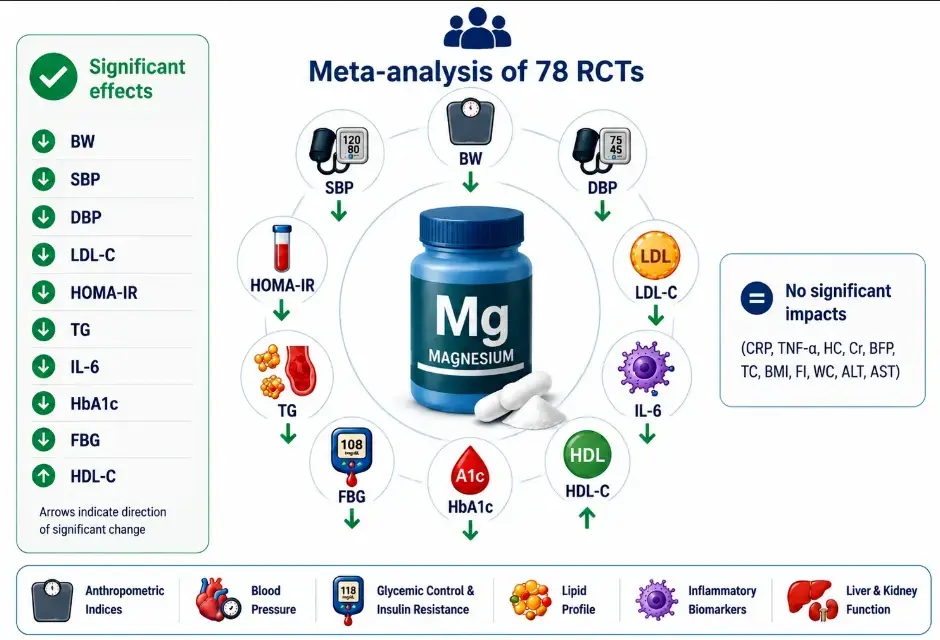
This systematic review pooled 78 randomized controlled trials with 5,226 adults, doses from 20 to 1,782 mg/day, durations 3 to 52 weeks. Four-fifths of the trials used ≥300 mg/day and two-thirds ran ≥12 weeks.
Improved: systolic BP −2.5 mmHg, diastolic BP −1.6 mmHg, fasting glucose −3.6 mg/dL, HbA1c −0.15%, HOMA-IR −0.48, triglycerides −9.2 mg/dL, LDL −3.2 mg/dL, HDL +1.5 mg/dL, IL-6 −1.1 pg/mL, body weight −0.7 kg.
Not improved: BMI, waist and hip circumference, body fat %, fasting insulin, total cholesterol, CRP, TNF-α, creatinine, ALT, AST.
Benefits for glucose, lipids, and blood pressure clustered in trials using ≥300 mg/day for ≥12 weeks, and in people who started off worse (higher fasting glucose, higher triglycerides, BP ≥130, HDL under 50). Safety looks reassuring: a prior review of 49 trials up to 972 mg/day found no serious adverse events, with loose stools the usual complaint — though people with chronic kidney disease need caution.
What this does not show / limitations. These are surrogate markers, not heart attacks or deaths. The authors are blunt: results show "favorable changes in intermediate cardiometabolic biomarkers rather than definitive evidence." GRADE certainty was very low for triglycerides and LDL, low for 8 more outcomes; heterogeneity ran as high as I²=97%. Publication bias was detected for LDL, body weight, and triglycerides. Only 3 trials lasted ≥25 weeks. Baseline magnesium status was reported so inconsistently that the key question — do deficient people benefit most? — could not be tested. Vitamin D was not measured in any analysis, so this says nothing directly about the D–Mg interaction.
Related in VitaminDWiki
- Overview Magnesium and vitamin D
- Magnesium: quick overview by a practicing doctor - May 2026
- Diseases at high risk if just low Vitamin D, low (D and Mg), low (D and Omega-3) – Perplexity AI
- Magnesium and Vitamin D - similar, different and synergistic
- Magnesium deficiency is now widespread — health consequences and best supplement forms
Following do not appear to be mentioned in this study
- Why Vitamin D is Useless without This Critical Nutrient (Magnesium)
- Magnesium and Vitamin D
- Magnesium supplement forms, including Liposomal
- Calcium-Magnesium Balance and How it Relates to Vitamin D - Sunil video Dec 2025
- Important for human health: Calcium, Magnesium, their ratio, and Phosphate
- 20 Vitamin D cofactors - Magnesium and Vitamin K2 are the most important for everyone
- Tinnitus is treated by Magnesium and perhaps Zinc or Vitamin D
- Weight loss and Vitamin D, Calcium, and Magnesium
- Cluster Headaches treated by high-dose Vitamin D, etc. (interview and transcript)
- ADHD significantly treated by daily Magnesium plus weekly Vitamin D – RCT
- Weekly Vitamin D plus daily Magnesium is great (reduced depression in obese women in this case)
Not mentioned in this study, but VitaminDWiki has many (10+) studies: