
Vitamin D helps sports - review of 45 RCTs
Vitamin Supplementation in Sports: A Decade of Evidence-Based Insights
Nutrients 2026, 18(2), 213; https://doi.org/10.3390/nu18020213
by Magdalena Wiacek *,Emilia Nowak,Piotr Lipka,Remigiusz Denda andIgor Z. Zubrzycki Department of Medical and Health Sciences, Radom University, Chrobrego 27, 26-600 Radom, Poland
Background: Vitamins are micronutrients involved in multiple physiological processes critical for athletic performance. Because athletes are often exposed to increased oxidative stress, higher metabolic turnover, and greater nutritional demands, which can potentially lead to deficiencies in vitamins, understanding vitamin supplementation as a function of sport discipline is of fundamental importance.
Methods: This narrative review synthesizes research findings from the past decade, supplemented with earlier studies where necessary, focusing on vitamins A, C, D, E, and the B-complex vitamins. Peer-reviewed literature was evaluated for evidence on the prevalence of deficiencies in athletes, physiological mechanisms, supplementation strategies, and their effects on performance, injury prevention, and recovery.
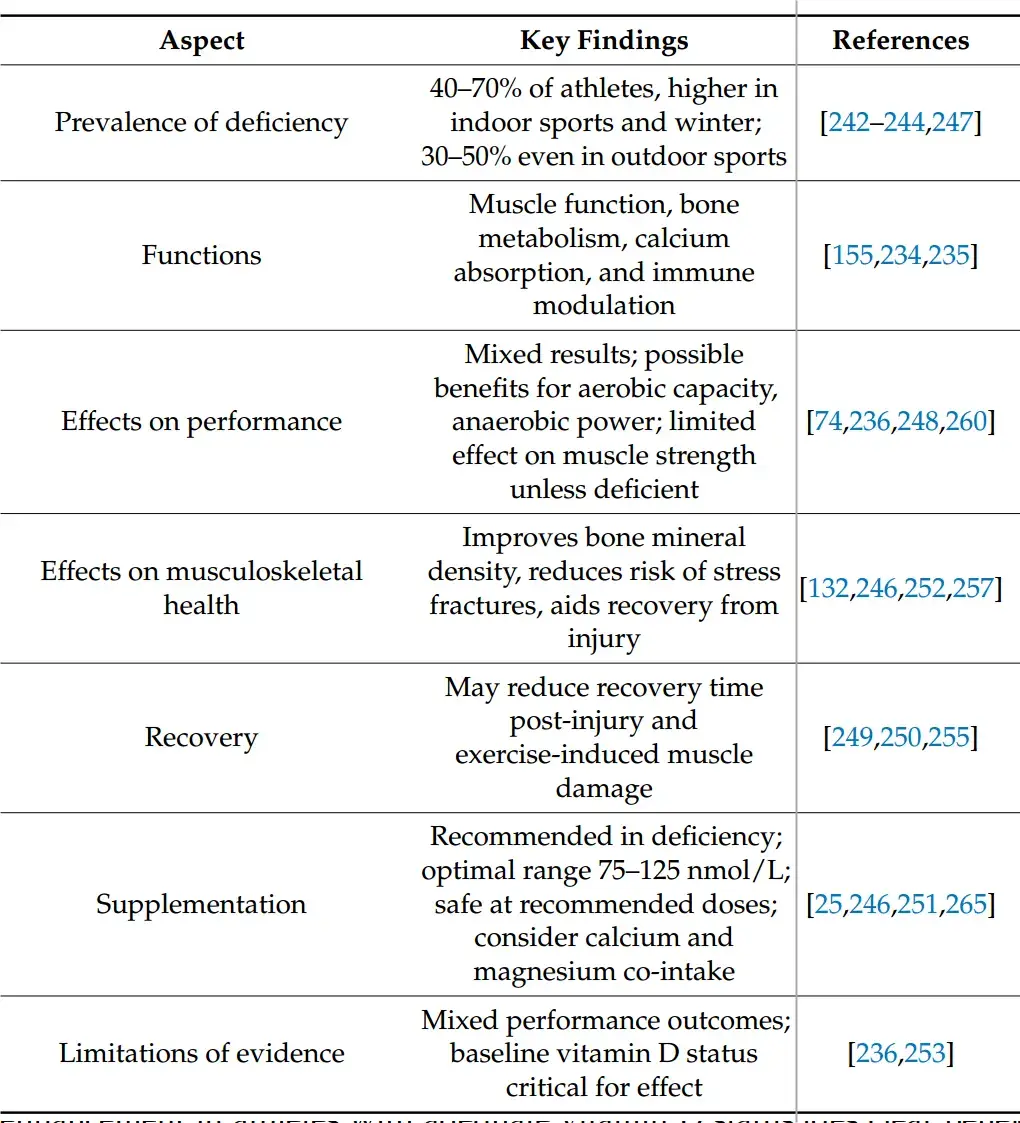
Results: Vitamin D deficiency is highly prevalent among athletes, particularly in indoor sports and during the winter months. Supplementation has been shown to improve musculoskeletal health and potentially reduce injury risk. The antioxidant vitamins C and E can attenuate exercise-induced oxidative stress and muscle damage; however, excessive intake may impair adaptive responses such as mitochondrial biogenesis and protein synthesis. Vitamin A contributes to immune modulation, metabolic regulation, and mitochondrial function, while B-complex vitamins support energy metabolism and red blood cell synthesis.
Conclusions: Vitamin supplementation in athletes should be individualized, targeting confirmed deficiencies and tailored to sport-specific demands, age, sex, and training intensity. Dietary optimization should remain the primary strategy, with supplementation serving as an adjunct when intake is insufficient. Further high-quality, sport-specific, and long-term studies are needed to establish clear dosing guidelines and to assess the balance between performance benefits and potential risks associated with over-supplementation.
Vitamin D Conclusion
"Vitamin D deficiency is common among athletes, particularly those involved in indoor sports or during winter seasons. Supplementation reliably improves bone mineral density, reduces the risk of stress fractures, and may enhance musculoskeletal recovery. Effects on performance (strength, aerobic capacity, anaerobic power) remain inconsistent. There is moderate certainty for benefits on bone and injury endpoints in deficient athletes, and low certainty for direct performance gains. Screening and targeted supplementation are recommended for individuals with deficiencies."
Related in VitaminDWiki
- NCAA trainers are getting on board the Vitamin D train (40-50 ng)
- Protein, muscles, bones and Vitamin D - many studies
- Athletic strength improved by Vitamin D – meta-analysis
- Elite soccer players with more vitamin D can change direction more quickly
- Exercise-induced muscle damage fought when enough vitamin D used for long enough – review
- Exercise Performance improved by Vitamin D or Magnesium – 2021
- 3X less muscle atrophy after ACL surgery if more than 40 ng of vitamin D
- Wattage produced by Elite indoor athletes: 3.9 W per kg if high Vitamin D vs 3.5 if low
- Faster Soccer sprints by teens from 5,000 IU of vitamin D for just 70 days
- Higher Cardiovascular fitness (VO2) if higher Vitamin D
Overview Sports and vitamin D contains:
Athletes are helped by vitamin D by:
Less sore/tired after a workout
Bones which do break heal much more quickly
Increased VO2 and exercise endurance Feb 2011
Indoor athletes especially need vitamin D
Professional indoor athletes are starting to take vitamin D and/or use UV beds
Olympic athletes have used UV/vitamin D since the 1930's
The biggest gain from the use of vitamin D is by those who exercise less than 2 hours per day.
Muscle strength improved when vitamin D added: 3 Meta-analysis
Reduced Concussions