
Osteoporosis interactions with gut, brain, liver and kidney (not just joints)
Osteoarthritis as a systemic disorder: multi-organ crosstalk in pathogenesis and therapeutic targeting
Review Front Immunol 2026 July doi: 10.3389/fimmu.2026.1871461
Tao Shu # 1, Xiaobin Shang # 1, Yan Zhou 1
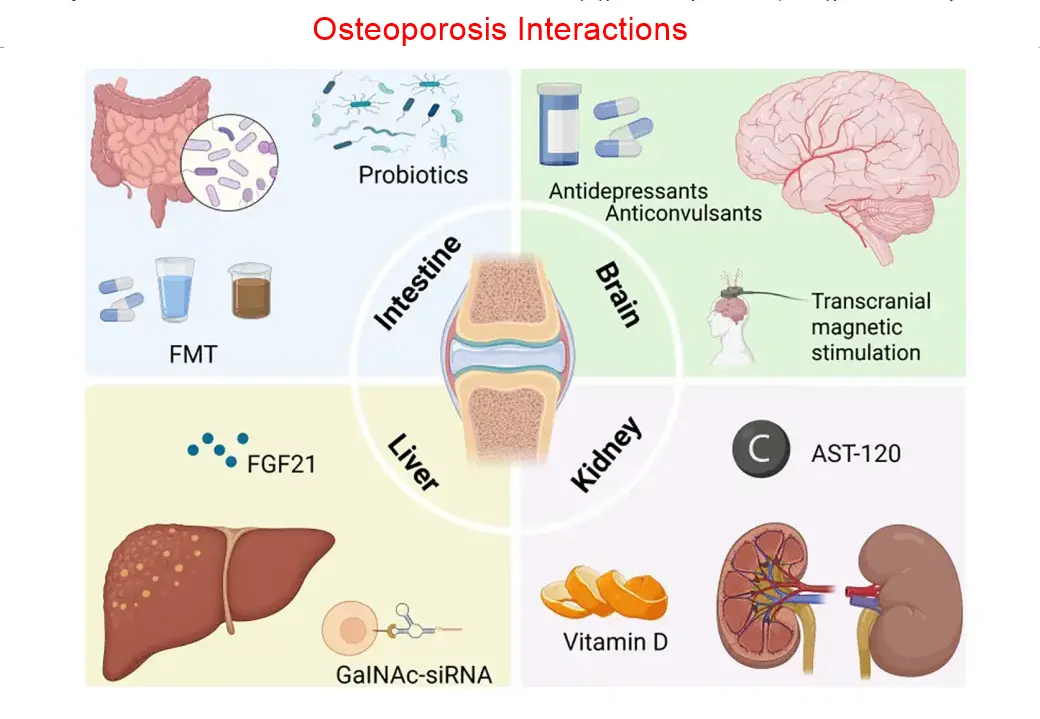
While osteoarthritis (OA) has long been viewed primarily as a localized, mechanically-driven joint disorder, emerging evidence suggests that systemic factors may play a significant modulating role in its pathogenesis. This review presents the "Gut-Brain-Liver-Kidney axis" as a potential regulatory framework to explore a conceptual shift towards a systemic perspective on this traditionally localized disease.
Available evidence is synthesized to clarify how gut microbiota dysbiosis and its metabolites contribute to systemic inflammation and disrupt joint homeostasis through specific pathways, such as the GUDCA-FXR-GLP-1 axis. Bacterial extracellular vesicles are further highlighted as essential nanoscale messengers facilitating communication between the gut and joints. Extending beyond gut health, the significant impact of central sensitization and neuroendocrine dysregulation in the brain is investigated as a key driver of chronic pain perception-a phenomenon often disproportionate to observable structural damage. Unlike mechanisms that directly cause cartilage breakdown, central sensitization primarily modulates pain experience and can secondarily influence disease progression by promoting maladaptive behaviors (e.g., reduced mobility).
The liver's involvement is also analyzed, particularly its disorders related to iron and lipid metabolism that promote chondrocyte ferroptosis. Furthermore, the analysis addresses how renal dysfunction intensifies OA by impairing vitamin D metabolism and leading to the accumulation of uremic toxins, such as indoxyl sulfate. By integrating these interconnected systemic pathways, a complex network of potential novel therapeutic targets is revealed.
Consequently, innovative strategies aimed at these axes are outlined, including the use of probiotics, vagus nerve stimulation, FGF21, GalNAc-siRNA, and vitamin D supplementation. This perspective encourages moving beyond symptom management toward mechanism-based, multi-targeted strategies. Key unanswered questions are outlined and priorities for future research and clinical translation in this evolving field are proposed.
Related in VitaminDWiki
- Osteoporosis treated by Vitamin D + Vitamin K2 + Vitamin B + Zinc + Mg + Silica etc (no surprise)
- Expert consensus: Osteoporosis needs Vitamin D
- Osteoporosis 60% more likely if low Magnesium intake
- High Selenium intake cuts risk of Osteoporosis in half - meta-analysis
- Another Osteoporosis group fails to recommend Vitamin D, etc. (perhaps fears losing business)
- Osteoporosis treatment – Vitamin D is the most cost-effective
- Osteoporosis treatment with Vitamin D – far healthier and 10X fewer afib events (vs bisphosphonates)
- 20X increase in vitamin D sold and 36 percent decrease in osteoporosis business in Australia
- Healthy bones need: Calcium, Vitamin D, Magnesium, Silicon, Vitamin K, and Boron – 2012
- 5 of the body's barriers (gut, skin, blood-brain, lung, vascular) are improved by Vitamin D
Fractures
Osteoporosis and Vitamin D Receptor
- Osteoporosis Risk varies with Vitamin D Receptor – three meta-analyses in 2020
- Osteoporosis is associated with genes such as the Vitamin D Receptor
- 2.8X higher risk of osteoporosis if COPD and modified vitamin D receptor genes
- Osteoporosis 2.8 X more likely if Vitamin D receptor (VDR) genes altered *
Osteoporosis and Gut
Osteoporosis and Liver