
Liver problems, including hepatitis, are associated with low Vitamin D - Meta-analysis 2025
Role of Vitamin D Supplementation in Chronic Liver Disease: A Systematic Review and Meta-Analysis of Randomized Controlled Trials
Nutrition Reviews, Nov 2025, Pages 2043–2054, https://doi.org/10.1093/nutrit/nuaf117
Petrana Martinekova , Mahmoud Obeidat , Mihaela Topala , Szilárd Váncsa , Dániel Sándor Veres , Ádám Zolcsák , Miheller Pál , László Földvári-Nagy , Peter Banovcin , Bálint Erőss
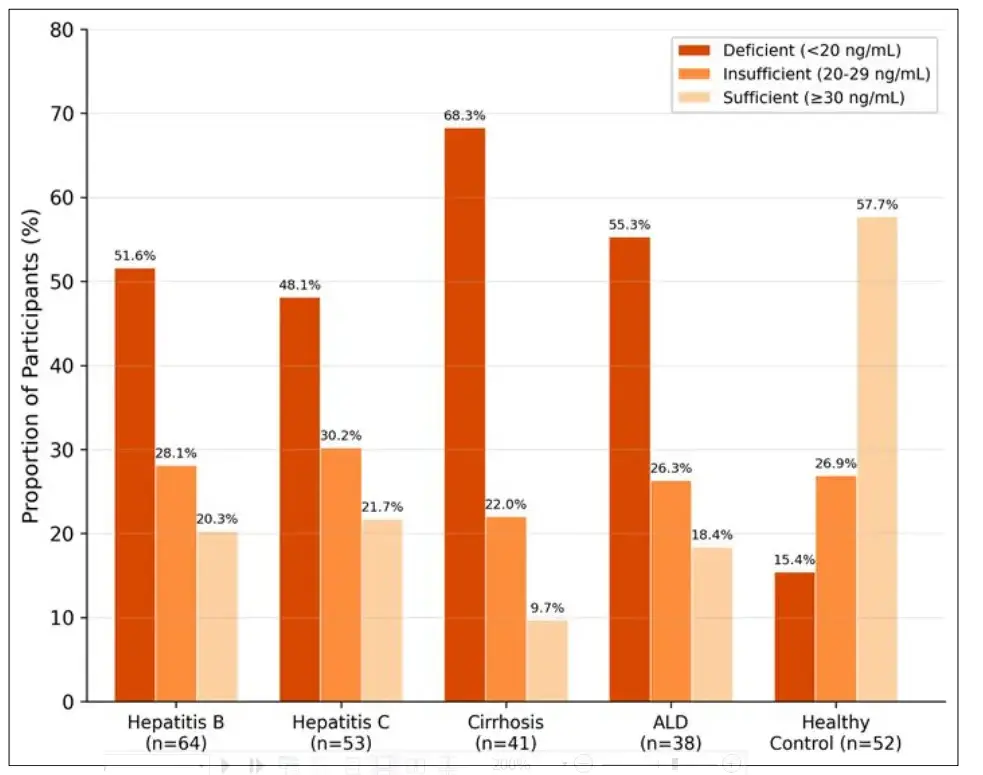
Context Vitamin D deficiency is highly prevalent in chronic liver disease. Although international societies recommend vitamin D supplementation in cases of proven deficiency, the impact of vitamin D on chronic liver disease remains uncertain.
Objective: Our aim was to evaluate the effects of vitamin D supplementation in patients with chronic liver disease by conducting a systematic review and meta-analysis of randomized controlled trials (RCTs).
Data Sources: We systematically searched PubMed, EMBASE and the Cochrane Library on July 2, 2024.
Data Extraction: Our primary outcomes involved survival, controlled attenuation parameter (CAP), liver stiffness measurement (LSM), and effects on changes in liver enzymes. Secondary outcomes included lipid profile and homeostasis model assessment of insulin resistance (HOMA-IR), among others. The pooled risk ratio (RR), mean difference (MD), and corresponding 95% CIs were calculated using the random-effects model.
Data Analysis: Forty-six RCTs were included, comprising 4084 patients. When we compared the vitamin D group with the control, the RR for overall survival was 1.14 (95% CI, 0.85-1.54; 4 RCTs) at 6 months and 0.99 (95% CI, 0.83-1.17; 4 RCTs) at the 12-month follow-up. Vitamin D supplementation did not result in a lower CAP (MD, −23.50 dB/m; 95% CI, −81.72 to 34.72; 3 RCTs) and LSM (MD, −0.65 kPa; 95% CI, −1.98 to 0.68; 3 RCTs). A significant reduction in HOMA-IR was observed in the vitamin D group (MD, −0.31; 95% CI, −0.62 to −0.01; 15 RCTs). Alanine aminotransferase (ALT) (MD, −4.98 IU/L; 95% CI, −8.28 to −1.68; 24 RCTs), aspartate aminotransferase (AST) (MD, −3.33 IU/L; 95% CI, −6.25 to −0.40; 23 RCTs), gamma-glutamyl transferase (GGT) (MD, −5.14 IU/L; −6.40; −3.88; 11 RCTs), triglycerides (MD, −7.59 mg/dL; 95% CI, −15.09 to −0.81), and insulin (MD −0.79 μIU/L; 95% CI, −1.36 to −0.21) were significantly reduced in the patients with vitamin D supplementation.
Conclusion: Our results showed significantly reduced ALT, AST, GGT, triglycerides, insulin, and HOMA-IR in the vitamin D–supplemented group; however, the effect was modest. In addition, there were no differences in survival, CAP, or LSM. Further RCTs with adequate power are warranted to clarify the results.
Systematic Review Registration: PROSPERO registration No. CRD42022370312
Related in VitaminDWiki
- Hepatitis B virus and Vitamin D - many studies
- Vitamin D can inhibit enveloped virus (e.g. Corona, Herpes, Bird Flu, Epstein, Hepatitis, RSV, etc.)
- Overview Liver and vitamin D
NAFLD
- NAFLD and Vitamin D - many studies
- Liposomal Gluthathione proven to fight T2D, Oxidative Stress, NAFLD, RA, HIV, PD, Autism, RSV, etc
- Vitamin D is one of only 2 ways to easily prevent NAFLD (380,000 people)
- Non-alcoholic fatty liver disease (NAFLD) reduced somewhat by 50,000 IU vitamin D every 2 weeks – RCT