
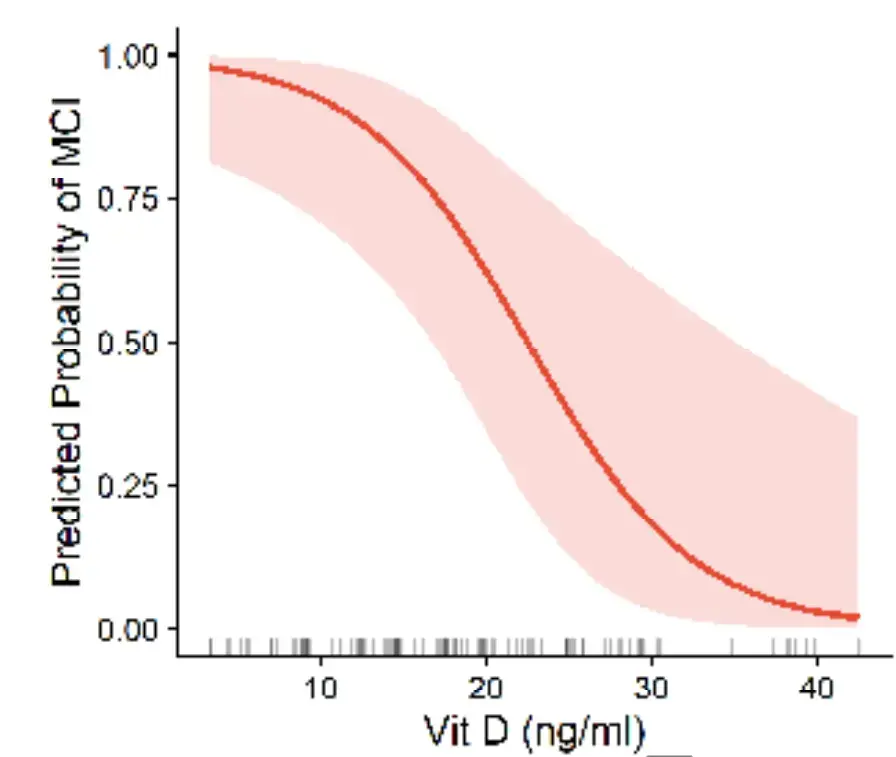
Mild cognitive impairment: = 94% if 8 ng of Vitamin D, 20% if 30 ng - observation (same day)
Neuronal Biomarkers and Micronutrient Status in Adults with Mild Cognitive Impairment
Nutrients (MDPI), 24 July 2026, https://doi.org/10.3390/nu18152428
Vineela Vepakomma, Basanth Geereddy, Saanvi S. Singireddy, Soumya R. Gurrala, Karthikeyan Ramanujam, G. Bhanuprakash Reddy (India)
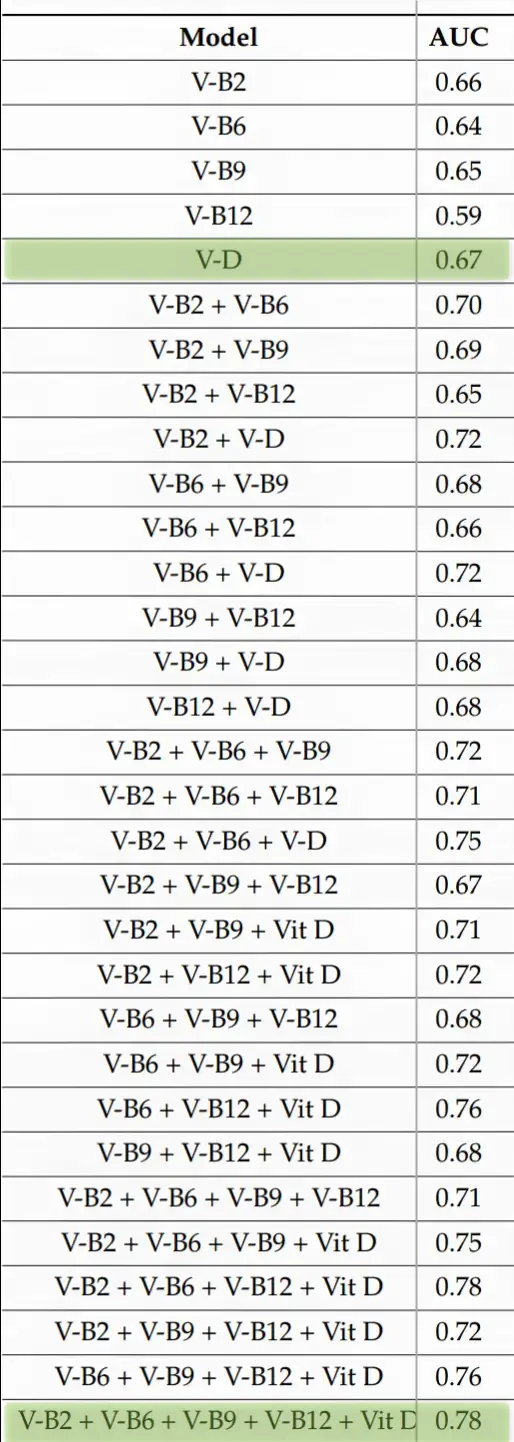
Area under curve (likelihood of being important)
(Vitamin D provides the most benefit)
Summary by Claude AI- July, 2026
Older adults with mild cognitive impairment (MCI) had notably lower vitamin D levels than those without, and of six vitamins tested, vitamin D separated the two groups better than any other single nutrient.
This was a community-based cross-sectional study of 184 adults aged 55–85 in Hyderabad, India, recruited through health camps between January 2024 and March 2025. Anyone already taking a multivitamin was excluded. Cognition was screened with the MoCA using a cut-off below 23; 36.4% scored as MCI.
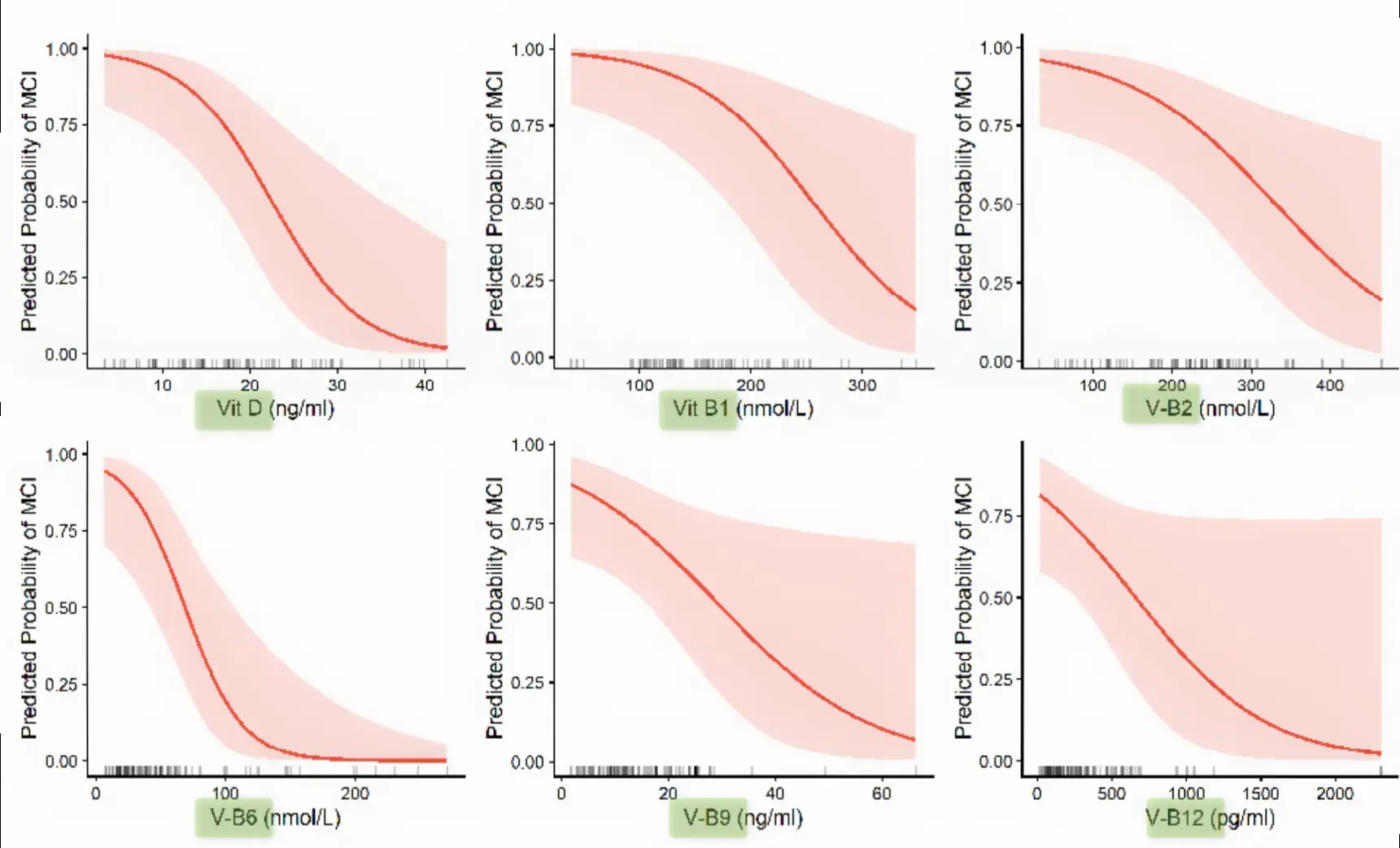
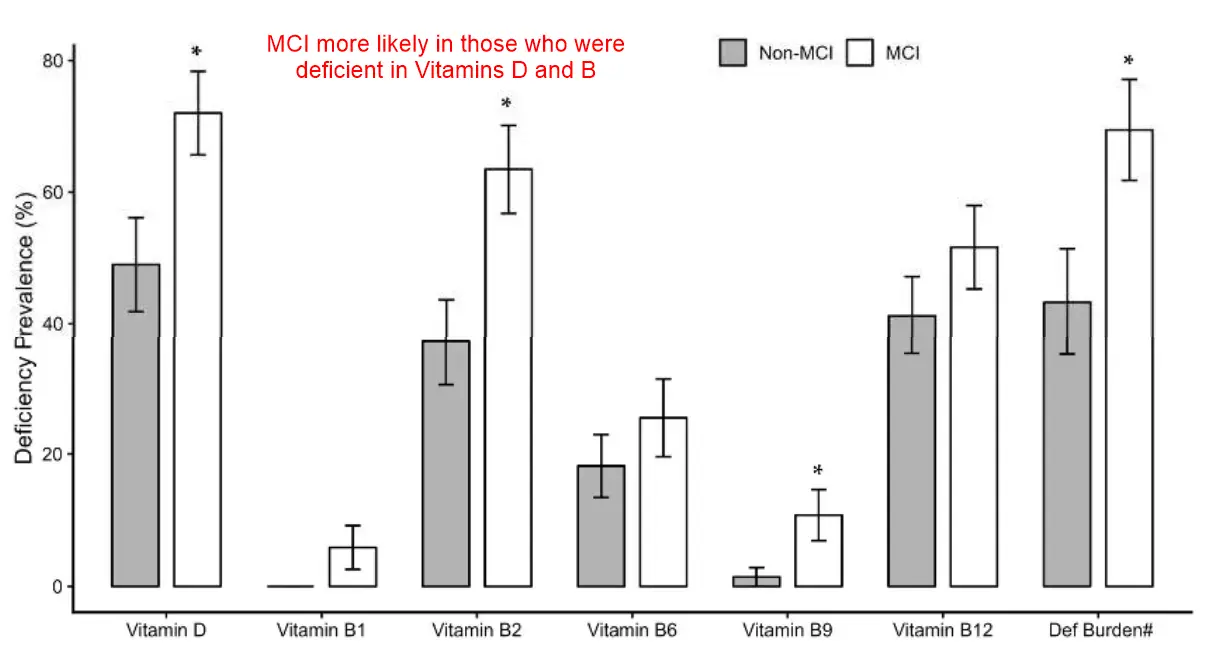
Median vitamin D was 20.9 ng/mL in the non-MCI group vs 16.2 ng/mL in the MCI group (p = 0.001). Deficiency was present in 72% of the MCI group vs 48% of the others. Higher vitamin D tracked with higher MoCA scores (r = 0.24). After adjusting for age, sex, education, BMI, HbA1c, systolic BP, T-tau and Nfl, the modeled probability of MCI dropped from 0.94 at the 10th percentile (8.3 ng/mL) to 0.20 at the 90th percentile (29.5 ng/mL). Vitamin D alone gave an ROC AUC of 0.67 — the highest of any single vitamin — rising to 0.78 when B2, B6 and B12 were added.
B1, B2, B6, B9 and B12 were also lower in the MCI group, and the cumulative count of deficiencies was higher (39% vs 19% had more than two).
What this does not show / limitations
- No causation. Cross-sectional, one blood draw. The authors say plainly that causal relationships cannot be established. Reverse causation is entirely live here: people whose cognition is slipping go outdoors less, eat worse, and are less likely to be supplementing.
- No supplementation, no dose, no duration, no intervention. Nobody was given vitamin D. Multivitamin users were deliberately excluded, so this is a snapshot of unsupplemented status only.
- Nothing above ~30 ng/mL. The 90th percentile was 29.5 ng/mL. The apparent benefit at higher levels is an extrapolation from a thin tail, and the confidence intervals widen sharply there.
- Vitamin D showed no link to the neuronal biomarkers. β-amyloid, T-tau and Nfl were higher and BDNF lower in the MCI group, but the only significant vitamin–biomarker correlations were B2 (with BDNF and Nfl) and B6 (with T-tau). Vitamin D was not among them — a null result the abstract's framing tends to blur.
- No vitamin D signal in any single cognitive domain. In the appendix table, deficient vs normal differed on none of the seven MoCA domains (all p > 0.05); the significant domain findings belonged to B2 and B9.
- Possible over-adjustment. T-tau and Nfl were included as covariates, but if they lie on the causal path they are mediators, not confounders.
- Small and local. 67 MCI cases, one city, a highly literate sample (95%, mostly 12+ years of education) — not representative of India generally.
- Deficiency cut-off not stated in the text for vitamin D, so the 72%/48% figures can't be anchored to a specific ng/mL threshold.
- Minor internal inconsistency: the Discussion swaps B2 and B6 relative to the Results when describing which vitamin paired with which biomarker.
- MDPI Nutrients — peer-reviewed and indexed, not predatory, though a fast-turnaround venue (submitted 5 June, accepted 18 July 2026). Government-funded (DBT and ICMR); no declared conflicts.
The study had no washout period
- Supplement users were excluded outright, with no stated time window, so recent ex-users may have been counted as non-users."
Report on the study by Grassrootshealth
New research suggests that maintaining adequate vitamin D and B vitamin status may help support healthy brain aging long before dementia develops.
Key Points
- Older adults with mild cognitive impairment had significantly lower blood levels of vitamin D, B1, B2, B6, and folate than those with normal cognitive function.
- Nearly 72% of participants with mild cognitive impairment were vitamin D deficient, compared to 48% of cognitively healthy adults.
- Higher vitamin D levels were associated with a dramatically lower predicted probability of mild cognitive impairment after adjusting for multiple health factors.
- Maintaining adequate vitamin D and B vitamin status may help support healthy cognitive aging and healthier brain biomarkers before dementia develops.
Risk of MCI resulting in dementia
Claude AI- July, 2026
Here's the picture from the literature. The single most important thing to know upfront: MCI is not a one-way street, and most people who have it never get dementia.
Annual conversion rate
This is the number usually quoted, and it depends heavily on where the people were recruited:
| Setting | Annual conversion to dementia |
|---|---|
| Community / population samples | ~3–5% per year |
| Memory clinics / specialist settings | ~10–15% per year |
| Pooled across all settings | ~5–10% per year |
The anchor reference is Mitchell & Shiri-Feshki's meta-analysis of 41 inception cohorts. Adjusting for sample size, the annual conversion rate from Mayo-defined MCI was 9.6% to all-cause dementia and 8.1% to Alzheimer's in specialist settings, versus 4.9% and 6.8% in community studies — and they concluded that most people with MCI will not progress to dementia even after 10 years of follow-up. Other reviews put high-income-country conversion at roughly 3–10% per year in community settings and 10–15% per year in clinical settings.
50% of MCI result in dementia in a decade
Over the follow-up periods those 41 cohorts covered, 39.2% progressed to dementia in specialist settings and 21.9% in population studies; the Alzheimer's-specific figures were 33.6% and 28.9%, and vascular dementia accounted for 6.2% and 5.2%. Put another way: at 10 years, more than half of participants had still not progressed.
A rough working set of numbers for a general older-adult population with MCI:
- 1 year: ~5–10%
- 3 years: ~20–25%
- 5 years: ~30–35%
- 10 years: ~40–50%, i.e. a coin flip
Median time to conversion, when it happens, runs around 3–3.5 years — one clinical series of 145 amnestic MCI patients found a mean of about 40 months, and progression was substantially slower in amyloid-negative than amyloid-positive patients.
Reversion — the number that gets left out
A large minority go back to normal cognition. Two 2016 meta-analyses land in the same territory: one pooling 25 studies found an overall reversion rate of about 24%, with 14% in clinic-based samples and 31% in community-based samples, and another found 8% in clinical studies and 25% in population studies, rising to 26% when restricted to higher-quality studies. So MCI diagnosed on a screening tool in the community is a soft, unstable label — which matters a lot for interpreting the Hyderabad paper, where 36% were classified MCI on a single MoCA administration.
Biomarker status changes everything
This is where the risk splits sharply. In an 11C-PIB PET study, 82% of amyloid-positive amnestic MCI patients converted to Alzheimer's over 3 years. In the Mayo population-based cohort, at 3 years 73.9% of amyloid-positive people with MCI were still free of AD dementia versus 90.8% of amyloid-negative — roughly 26% vs 9% converting. Amyloid-negative amnestic MCI progressed at about 6.3% per year, and often to non-Alzheimer's causes — vascular dementia, PSP and others.
So the honest framing is: MCI plus amyloid positivity is a high-risk state (roughly 50–80% over 3–5 years); MCI without it is close to ordinary age-related risk.
Related in VitaminDWiki
MCI and Vitamin D
- Vitamin D: The most popular dietary supplement for people with mild cognitive impairment (41%)
- Cognitive impairment 5 percent less likely for each ng more of Vitamin D (Parkinson’s)
- Cognitive Impairment and Dementia often associated with low Vitamin D
- Cognitive impairment 4X more likely when vitamin D less than 10 ng
- Cognitive problems in young adults increased 9.1X in a decade - Nov 2025
- Cognitive Decline fought by Vitamin D, especially when combined with other supplements
- Mild cognitive impairment is 3X more likely to become dementia in one year if low vitamin D
- Cognitive impairment 4X more likely when vitamin D less than 10 ng
Dementia and Vitamin D
- Brain regions that shrink with dementia have high Vitamin D Receptor concentrations
- Dementia 5X less likely if have good levels of Vitamin D, Omega-3 and Homocystine
- Less UV associated with more dementia
- Dementia prevented by Omega-3, Vitamin D, etc. book and video
- Seniors taking any amount of vitamin D reduced risk of dementia by 40%
- Dementia risks reduced by Vitamin D
- Vitamin Supplementation and Dementia - Review
- Dementia risk increases with latitude (less vitamin D)
- Dementia 19X more likely if low vitamin D
Alzheimer's and Vitamin D
- End of Alzheimer's videos, transcripts - many studies
- The End of Alzheimer's and Dementia if adjust Vitamin D, B-12, Iron, Omega-3, etc.
- Alzheimer's proven to be prevented and treated - RCT 2026
- Vitamin D may protect the Alzheimer's brain through 5 pathways - review 2026
- Brain health improved by Vitamin D - review of 90 studies
- Consensus: Vitamin D deficiency is related to Alzheimers (9 of 10 studies)