
Insulin resistance 40% less likely in non-diabetics having a good level of Vitamin D
Higher Vitamin D Status is Associated With Lower Insulin Resistance in Non-Diabetic U.S. Adults: A Two-Decade Nationwide Analysis
SN Comprehensive Clinical Medicine. Aug 2026. Volume 8, article number 344 (2026) https://doi.org/10.1007/s42399-026-02568-5 PDF behind a paywall
Hafiz M. Ahmed, Ubaid ur Rehman, Muhammad Owais, Ehsan Zaib & M. Rehman Rafiq
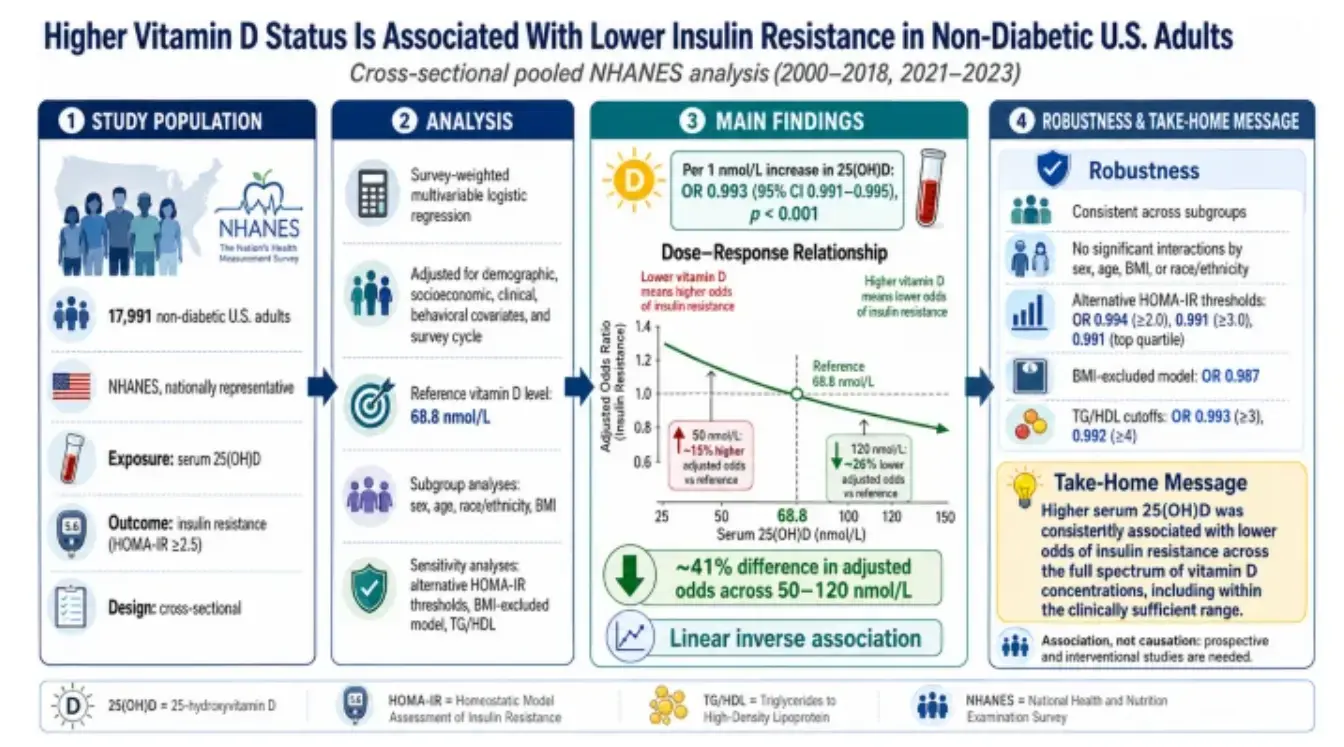
Background Beyond its established role in skeletal metabolism, vitamin D has been linked to glucose homeostasis and insulin sensitivity. Vitamin D receptors are expressed in tissues involved in glucose regulation, but large-scale population evidence characterizing the association between serum 25-hydroxyvitamin D [25(OH)D] and insulin resistance remains limited. We hypothesized that lower serum 25(OH)D concentrations would be associated with higher odds of insulin resistance.
Methods We conducted a cross-sectional analysis pooling ten NHANES cycles (2001–2018, 2021–2023), comprising 17,991 non-diabetic U.S. adults. Insulin resistance was defined using the Homeostatic Model Assessment of Insulin Resistance (HOMA-IR). Survey-weighted multivariable logistic regression examined the association between serum 25(OH)D and insulin resistance, adjusting for demographic, socioeconomic, clinical, and behavioral covariates. Subgroup and sensitivity analyses tested robustness across alternative outcome definitions.
Results Of 17,991 participants, 7,538 (41.9%) had insulin resistance. Each 1 nmol/L increment in 25(OH)D was associated with 0.7% lower odds of insulin resistance (OR = 0.993; 95% CI: 0.991–0.995; p < 0.001), following a linear dose–response pattern (quadratic p = 0.109). Participants with 50 nmol/L had 15% higher adjusted odds, whereas those with 120 nmol/L had 26% lower adjusted odds versus the reference level of 68.8 nmol/L. Findings were consistent across subgroup analyses, alternative HOMA-IR thresholds, TG/HDL-based definitions, and a BMI-excluded model.
Conclusion Higher serum 25(OH)D was independently associated with lower odds of insulin resistance in non-diabetic U.S. adults in a continuous, graded manner. These findings suggest that serum 25(OH)D may serve as a metabolic biomarker associated with insulin resistance, while prospective and interventional studies are needed to clarify temporality and causality.
Related in VitaminDWiki
- Vitamin D might a risk factor of insulin resistance, diabetes, obesity, etc. (50 ng)
- Insulin Resistance is associated with low Vitamin D (both diabetic and non-diabetic) – meta-analysis
- How Vitamin D both prevents and treats insulin resistance (Diabetes)
- Insulin resistance 35 percent less likely when vitamin D levels raised by 30 ng
Diabetes
- Overview Diabetes and vitamin D
- More than 50% increase per decade: asthma, obesity, diabetes, hypertension, cancer, etc. - 2025
- Diabetes and Vitamin D meta-analyses - many studies
- Vitamin d treats Type II Diabetes in many ways (14 article review)
- US young adults – 24 percent have prediabetes (many low-cost ways to treat)
- Take Vitamin D to prevent prediabetes from progressing into diabetes – American Diabetes Association – 2024