
IBD treated by Vitamin D, provided enough or a gut-friendly form is used
Vitamin D Supplementation for Disease Activity and Maintenance of Remission in Inflammatory Bowel Disease: A Systematic Review and Meta-analysis
Gastroenterology & Endoscopy Pre-proof Feb 2026 https://doi.org/10.1016/j.gande.2026.02.002
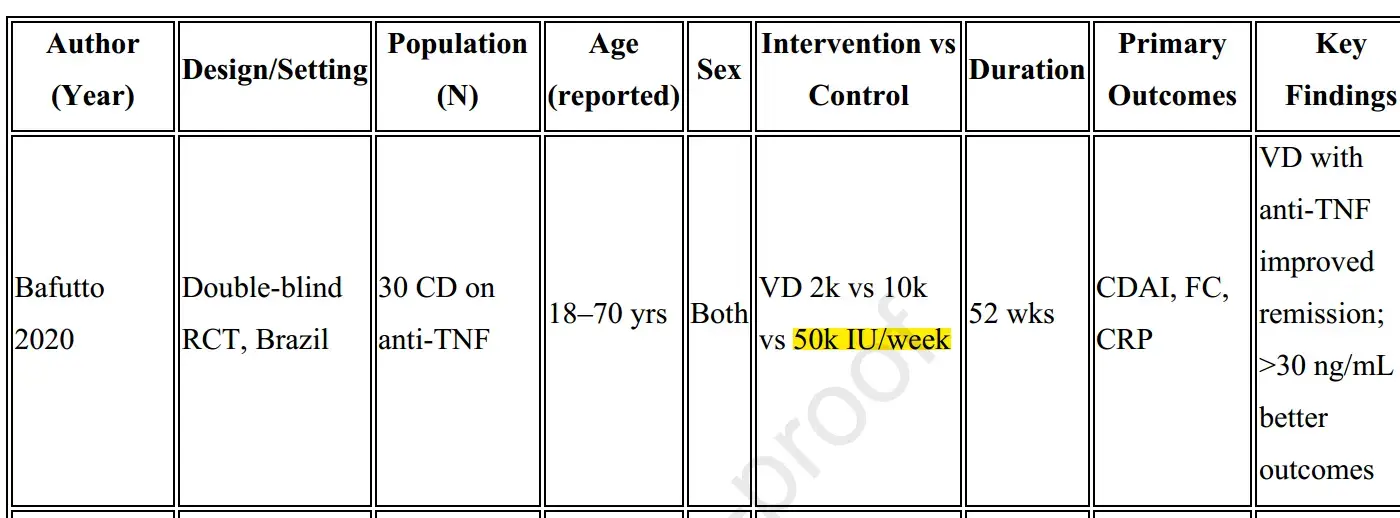
Only one RCT used enough Vitamin D (50K/week)- strangely, it was not reported in the summary table
Inflammatory bowel disease (IBD) has been linked to immune dysregulation and vitamin D deficiency, leading to growing interest in vitamin D supplementation as a potential adjunctive therapy. This systematic review and meta-analysis evaluated the effects of vitamin D supplementation on disease activity, inflammatory markers, and vitamin D status in patients with IBD. PubMed (MEDLINE), Embase, and the Cochrane Library were searched according to PRISMA guidelines, and studies were selected via the PICOS framework. Random-effects meta-analyses were conducted in R via restricted maximum likelihood estimation with Hartung–Knapp adjustment, and heterogeneity and influence diagnostics were assessed. Vitamin D supplementation significantly increased serum 25-hydroxyvitamin D levels (11 studies; SMD = 1.24, 95% CI 0.52–1.95; p < 0.001), although heterogeneity was substantial (I2 ≈ 94%). In pooled analyses of disease activity (4 studies), vitamin D supplementation was not associated with a statistically significant reduction in disease activity under Hartung–Knapp modeling (SMD = −0.56, 95% CI −1.94-0.82; p = 0.29; I2 = 87.8%). Influence diagnostics identified one trial as a dominant outlier; excluding this study attenuated the pooled effect (SMD = −0.19, 95% CI −0.59 to 0.21; p = 0.17) and eliminated heterogeneity. No statistically significant pooled effects were observed for inflammatory markers, including C-reactive protein and TNF-α, although some individual studies reported reductions. Overall, vitamin D supplementation reliably improves serum vitamin D levels in patients with IBD but does not provide consistent or robust evidence of clinically meaningful improvement in disease activity. Any potential clinical benefit appears modest, heterogeneous, and sensitive to influential studies, underscoring the need for larger, well-designed trials with standardized dosing and relapse-based outcomes.