
The immune system is better @ 40 ng level of Vitamin D
Serum 25(OH)D concentrations are differentially associated with innate and adaptive immune cell markers, with threshold effects near 40 ng/mL: A cross-sectional study
Nutr Res. 2026 Aug 5:154:32-45. doi: 10.1016/j.nutres.2026.08.001. PDF behind paywall
Peng Lei 1, Shaoyan Wu 1, Rong Luo 1, Binyang Tang 1, Sicen Wu 2
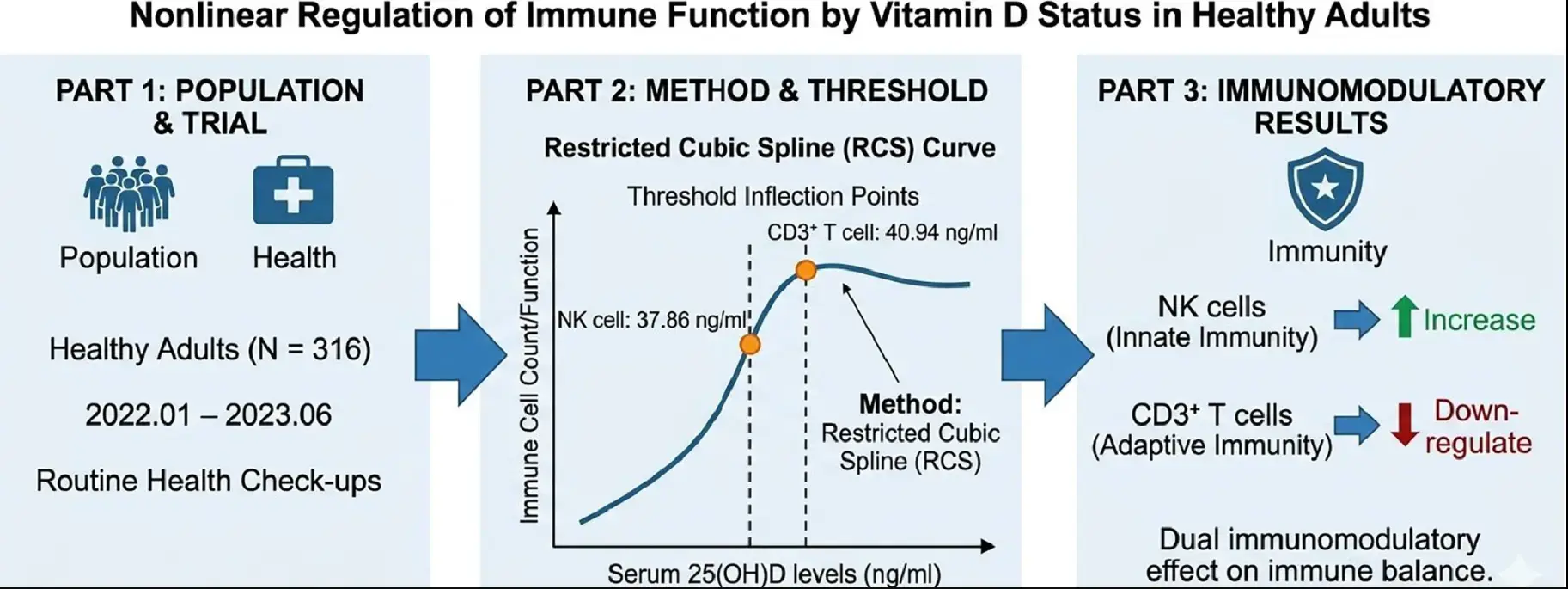
The nonlinear relationship and threshold effects of vitamin D on immune function in healthy adults remain unclear. This cross-sectional study of 316 healthy adults (January 2022 to June 2023) investigated associations between serum 25-hydroxyvitamin D (25(OH)D) concentrations and peripheral blood immune parameters (CD3+ T lymphocytes, CD4+ T cells, CD19+ B cells, and natural killer [NK] cells) quantified by flow cytometry. Restricted cubic spline and piecewise regression models evaluated nonlinear relationships and inflection points. Compared to the low 25(OH)D group (<28.45 ng/mL), the high group (>28.45 ng/mL) had higher NK cell counts (306.00 vs 272.50, P < .01) and percentages (15.52% vs 14.21%, P < .01), but lower CD3+ T cell percentage (69.99% vs 73.20%, P < .01). Multivariate regression confirmed that 25(OH)D was negatively associated with CD3+ T cell percentage (β = -0.16, P < .001), and positively with NK cell count (β = 3.62, P = .002) and NK cell percentage (β = 0.16, P < .001). Restricted cubic spline analyses revealed significant threshold effects, with inflection points at 40.94 ng/mL for CD3+ T cell percentage (P = .003), 37.86 ng/mL for NK cell count (P = .005), and 40.94 ng/mL for NK cell percentage (P = .022). Subgroup analyses showed stronger correlations in males and individuals 40 to 59 years of age (P < .05). Our findings suggest that vitamin D may exert threshold-dependent dual immunomodulatory effects-enhancing innate immunity (NK cells) while suppressing adaptive immune activation (CD3+ T cells). Higher 25(OH)D concentrations (around 40 ng/mL) were associated with distinct immune profiles in this healthy cohort. These associations may provide preliminary insights for future studies, although causal relationships cannot be inferred from this cross-sectional design.
Conclusion: clipped from web (>40 ng increases innate and decreases adaptive)
In summary, the present study demonstrates differential associations between 25(OH)D concentrations and innate (NK cells) vs adaptive (CD3+ T lymphocytes) immune markers, with threshold effects identified near 40 ng/mL. These cross-sectional findings suggest that higher VitD concentrations above this level were associated with enhanced innate immunity and reduced adaptive immune activation. Nevertheless, it is not possible to establish causal relationships. Future research may benefit from . . . .
Click here to see some of the references
- S. Sha er al. Associations of 25-hydroxyvitamin D status and vitamin D supplementation use with mortality due to 18 frequent cancer types in the UK Biobank cohort Eur J Cancer (2023)
- M. Hewison er al. Vitamin D and barrier function: a novel role for extra-renal 1α-hydroxylase Mol Cell Endocrinol (2004)
- N. Riazati er al. Association of vitamin D status with immune markers in a cohort of healthy adults J Nutr (2025)
- A.G. Vassiliou er al. Vitamin D deficiency correlates with a reduced number of natural killer cells in intensive care unit (ICU) and non-ICU patients with COVID-19 pneumonia Hellenic J Cardiol (2021)
- G. Daryabor er al. A review of the critical role of vitamin D axis on the immune system Exp Mol Pathol (2023)
- N. Charoenngam er al. Immunologic effects of vitamin D on human health and disease Nutrients (2020)
- MF. Holick Vitamin D deficiency N Engl J Med (2007)
- B. Prietl er al. Vitamin D and immune function Nutrients (2013)
- DD. Bikle Vitamin D regulation of immune function Curr Osteoporos Rep (2022)
- C.A. Peterson er al. Serum tumor necrosis factor-alpha concentrations are negatively correlated with serum 25(OH)D concentrations in healthy women J Inflamm (2008)
- L. Jeng er al. Alterations in vitamin D status and anti-microbial peptide levels in patients in the intensive care unit with sepsisJ Transl Med (2009) *C.J. Rosen er al. IOM committee members respond to endocrine society vitamin D guideline J Clin Endocrinol Metab (2012)
- M.B. Demay er al. Vitamin D for the prevention of disease: an endocrine society clinical practice guideline J Clin Endocrinol Metab (2024)
- C.F. Munns er al. Global consensus recommendations on prevention and management of nutritional rickets J Clin Endocrinol Metab (2016)
- MF. Holick A call to action: pregnant women in-deed require vitamin D supplementation for better health outcomes J Clin Endocrinol Metab (2019)
- K. Amrein er al. Vitamin D deficiency 2.0: an update on the current status worldwide Eur J Clin Nutr (2020)
- A. Rusińska er al. Vitamin D supplementation guidelines for general population and groups at risk of vitamin D deficiency in Poland-Recommendations of the Polish Society of Pediatric Endocrinology and Diabetes and the Expert Panel with participation of national specialist consultants and representatives of scientific societies—2018 update Front Endocrinol (2018)
Related in VitaminDWiki
- Ways to Boost the Aging Immune System
- Vitamin D targets 61 Immune system genes (based on response to 80,000 IU)
- Vitamin D is important for the immune system to correctly function (no surprise)
- Vitamin D energizes the innate and adaptive immune systems to fight lung inflammation
- Gut problems treated by Vitamin D (helps both innate and adaptive immunity - gut-friendly forms are best)
- Vitamin D helps both the Innate and Adaptive immune systems
- 19X fewer COVID-19 infections if innate immune system activated – trial
40 ng of Vitamin D
- 80+ health problems substantially reduced when Vitamin D is above 40 ng
- 40 ng response to 4,000 IU daily Vitamin D for 2 months (and 60 ng for 8,000 IU)
- 50,000 IU of Vitamin D once every 2 weeks achieved 40 ng in 3 months – RCT
- Live longer if have more than 40 ng of Vitamin D (gene analysis of 10,500 people)
- Pregnant women need at least 40 ng of Vitamin D (Wagner, genes)
>40 ng of vitamin D
- 40-50 ng level of Vitamin D often recommended
- Many diseases prevented if Vitamin D level higher than 50 ng -Sunil
- Discussion of COVID and 50 ng of Vitamin D (video and transcript)– Dr. Campbell
- 50 ng level of Vitamin D proven to fight many diseases - Whittle
- Mortality reduced by 35 percent if everyone had 50 ng of vitamin D - Grant
- Is 50 ng of vitamin D too high, just right, or not enough