
Risk of Cesarean 2X higher if low vitamin D
Maternal Vitamin D Status and Delivery by Cesarean - 2012
Nutrients 2012, 4(4), 319-330; doi:10.3390/nu4040319
Theresa O. Scholl 1 scholl@umdnj.edu , Xinhua Chen 1 and Peter Stein 2
We examined the association of vitamin D deficiency to risk of cesarean delivery using prospective data in a cohort of 1153 low income and minority gravidae. Circulating maternal 25-hydroxyvitamin D and intact parathyroid hormone were measured at entry to care 13.73 ± 5.6 weeks (mean ± SD). Intake of vitamin D and calcium was assessed at three time points during pregnancy. Using recent Institute of Medicine guidelines, 10.8% of the gravidae were at risk of vitamin D deficiency, and 23.8% at risk of insufficiency. Maternal 25-hydroxyvitamin D was related positively to vitamin D and calcium intakes and negatively to circulating concentrations of parathyroid hormone. Risk for cesarean delivery was increased significantly for vitamin D deficient women; there was no increased risk for gravidae at risk of insufficiency.
When specific indications were examined, vitamin D deficiency was linked to a 2-fold increased risk of cesarean for prolonged labor .
Results were the similar when prior guidelines for vitamin D deficiency (25(OH)D < 37.5nmol/L) and insufficiency (37.5–80 nmol/L) were utilized.
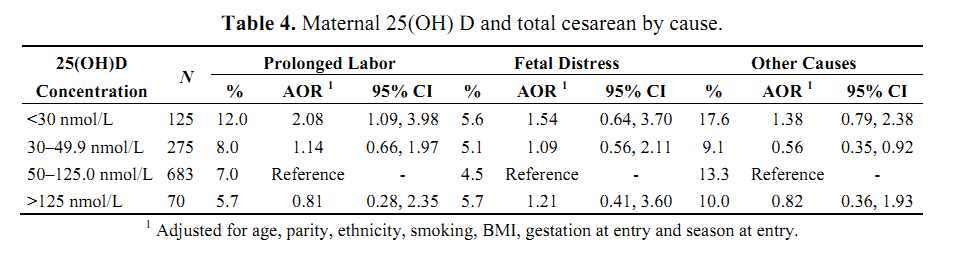
(AOR = Adjusted Odds Ratio) PDF
Summary of RCT without enough participants:
400 IU ==> 25% Cesarean; 4000 IU ==> 14% Cesarean
2X less likely to have emergency Cesarean if 3 ng high level of vitamin D - March 2026
Association of Serum 25-Hydroxyvitamin D [25(OH)D] Levels with Vaginal Delivery in Pregnant Women: Observational Case-Control Study from Türkiye
Front. Med.Sec. Obstetrics and Gynecology PDF in the future
Halime SELEN 1,2; Nurten ÖZÇALKAP 1; Egehan BİLEN 3,4
Objective: The aim of this study is to evaluate the relationship between maternal serum 25-hydroxyvitamin D [25(OH)D] levels and the likelihood of vaginal delivery. Materials and Methods: This observational case-control study was conducted with a total of 298 women, comprising a case group of those who were unable to deliver vaginally and underwent emergency cesarean section (n=49), and a control group of those who delivered vaginally (n=249). The study data were collected using a questionnaire developed in line with the relevant literature. To explore the effects of independent variables on the dependent variable, both univariate and multivariate logistic regression analyses were performed.
Results: According to the findings of our study, higher serum 25(OH)D levels were significantly associated with a reduced risk of cesarean delivery (β=-0.369, p=0.001). Specifically, each 1 ng/mL increase in serum 25(OH)D levels reduces the risk of cesarean delivery by approximately 30.8% [Exp(β)=0.692, 95% CI=0.611-0.783]. On the other hand, a high body mass index (BMI) pre-pregnancy and at the time of delivery, excessive gestational weight gain, and the presence of chronic diseases were associated with a higher risk of cesarean delivery (p<0.05). In addition, giving birth at a later gestational week was found to be associated with a higher rate of vaginal delivery (p<0.05). No significant association was found between mode of delivery and maternal age, total number of This is a provisional file, not the final typeset article pregnancies, previous vaginal delivery, pre-pregnancy family planning method, neonatal birth weight, the total number of non-stress tests (NSTs) performed during pregnancy, or the number of antenatal physician visits (p>0.05).
Conclusion: Higher serum vitamin D levels were associated with higher likelihood of vaginal delivery. In this context, optimizing vitamin D status through sunlight exposure, nutrition, or supplementation could represent an important step in protecting maternal and neonatal health.