
Observational evidence, not RCTs, is the right test for a nutrient like vitamin D - review
Vitamin D and Health: Establishing Causal Relationships Through Observational Evidence and Hill's Criteria in a Biological Framework
Nutrients (MDPI), 4 September 2026, https://doi.org/10.3390/nu18172902
William B. Grant, Sunil J. Wimalawansa
Summary by Claude - September, 2026
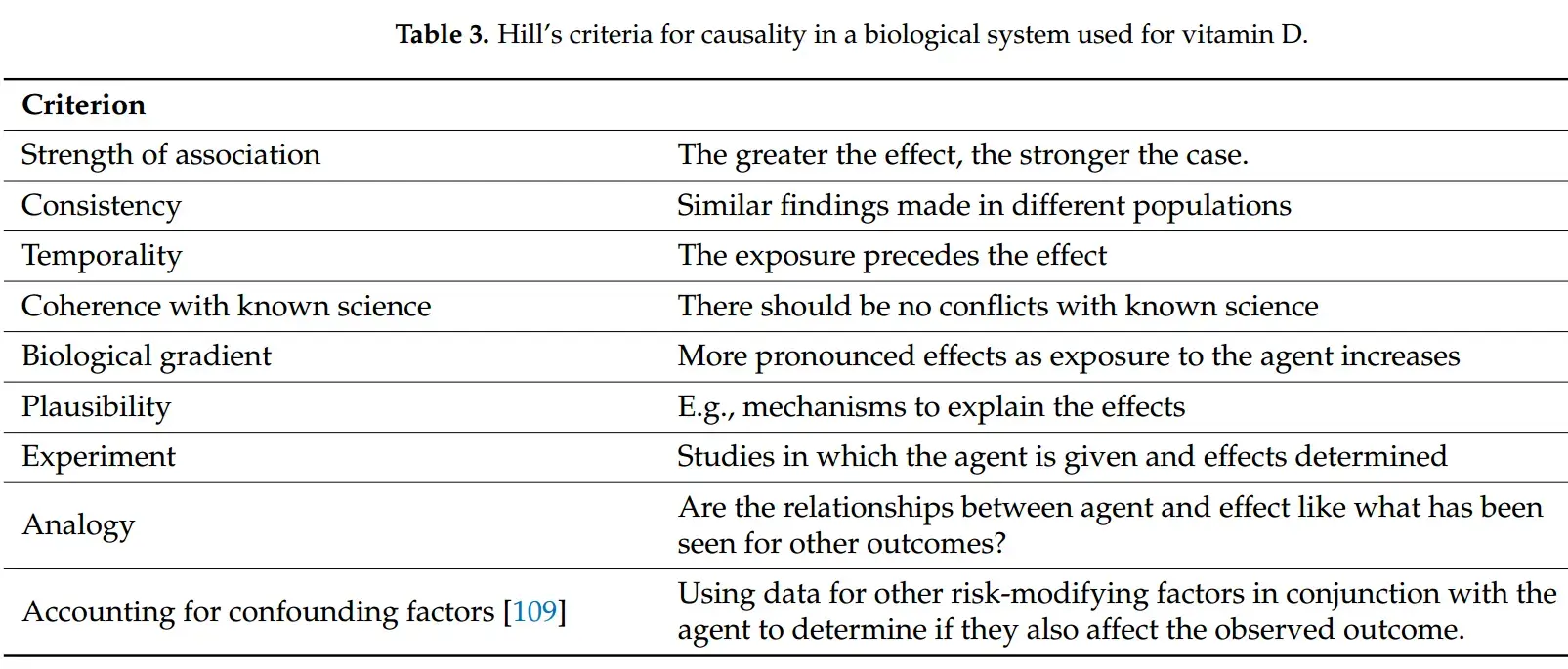
This narrative review argues that the case for vitamin D preventing major chronic disease should be judged from observational evidence rather than from randomized trials — and that by that standard the evidence is already strong enough to act on. The authors reviewed roughly 20 published Bradford Hill causality analyses, examining more than half in detail, across nine conditions: cancer, cardiovascular disease, blood pressure, COVID-19, type 1 and type 2 diabetes, periodontal disease, multiple sclerosis, and dementia. For each they judged Hill's criteria — strength, consistency, temporality, dose-response, plausibility, mechanism — to be substantially satisfied.
The central argument is about trial design. Large RCTs such as VITAL, ViDA, and D-Health enrolled mostly people whose 25(OH)D was already adequate (often above 30 ng/mL), allowed control groups 400 IU/day or more, ran short, and analyzed by assigned dose rather than achieved blood level. The authors' target is 40-80 ng/mL, ideally above 50 ng/mL. Supporting examples: a reanalysis of the D2d trial found progression from prediabetes to diabetes much lower (HR 0.29) in those reaching above 50 ng/mL versus 20-30 ng/mL; an Iranian screening program in 1,800 pregnant women starting near 11 ng/mL saw pre-eclampsia down 60%, gestational diabetes 50%, preterm birth 40%.
What this does not show: no new data were collected. A narrative review chooses its own evidence — there is no reproducible search protocol and no risk-of-bias scoring, and both authors are long-standing advocates of the position being defended (Grant discloses supplement-industry research funding, resumed in 2026). Hill's criteria are a judgment framework, not a statistical test, and ecological and cohort data remain open to confounding — low 25(OH)D also marks obesity, illness, and indoor living.
Clipped from PDF
"Maintaining serum 25(OH)D at ≥50 ng/mL, ideally 50–80 ng/mL, appears to support nearly all vitamin D-responsive processes without increasing adverse effects."
Related in VitaminDWiki
- Over 1,000 studies prove that Vitamin D works
Vitamin D-disease associations vary with the type of study – RCT, Observational, MR
Vitamin D not improve health if any of 7 errors are made by trials
- Using natural experimental studies to guide public health action, not RCTs
- Vitamin D data - Why observation is preferred to clinical trial - Grant Oct 2025
- What Each Vitamin D Level Actually Treats — From Rickets at 30 ng to MS at 150 ng
| Vitamin D | Treats |
| 150 ng | Multiple Sclerosis ✻ |
| 80 ng | Cluster Headache ✻ Reduced office visits by 4X ✻ |
| 70 ng | Sleep ✻ |
| 60 ng | Breast Cancer death reduced 60% Preeclampsia RCT |
| 50 ng | COVID-19 T1 Diabetes Fertility Psoriasis Infections Review Infection after surgery |
| 40 ng | Breast Cancer 65% lower risk Depression ACL recovery Hypertension Asthma? |
| 30 ng | Rickets |
When Should We Rely on Observational Studies? Dr. Greger video Sept 2026
a related 2022 Video by Dr. Greger
Observational Studies Show Similar Results to Randomized Controlled Trials