
More Weight loss if you add Vitamin D and Receptor activators: Berberine, Butyrate, etc
Question: What activates the VDR?
Various things increase the activation of the vitamin D receptor, such as Magnesium, Omega-3, Resveratrol, Quercetin, Zinc, Boron, Ginger, Curcumin, Sulfroaphane, Butyrate, Berberine, Liposomal Glutathione, high-concentration vitamin D, etc. Are any activators appropriate for Weight loss?
Tier 1 — real human weight/metabolic endpoints
- Berberine — the strongest of your list by a wide margin. AMPK activation, glycemic effects approaching metformin in head-to-head trials, meta-analyses showing BMI/waist reduction, and it shifts the microbiome toward butyrate producers. Flag the CYP3A4/P-gp interaction prominently — it's a genuine contraindication with statins, cyclosporine, and many others.
- Butyrate — mechanistically the most interesting for your audience: FFAR2/3 signaling → endogenous GLP-1 and PYY release, plus improved insulin sensitivity and energy expenditure. Ties directly into your existing GLP-1/vitamin D work, and butyrate is the strongest bidirectional link between VDR and the microbiome. Human oral-supplement trials are still thin; dietary fiber → endogenous production is the better-supported route.
- Curcumin — meta-analyses show modest weight/BMI/waist reduction plus lower leptin and higher adiponectin. Doubles as your CYP24A1 inhibitor, so it's already carrying weight in your framework.
Tier 2 — deficiency-correction effects, meaningful in obese populations
- Magnesium — obesity is strongly associated with low magnesium status, and it's the cofactor for every enzyme in the pathway plus a determinant of insulin sensitivity. Not a weight-loss agent per se, but arguably the highest-yield correction in this population.
- Zinc — VDR's DNA-binding domain is a zinc finger, so this is structural rather than modulatory. Meta-analyses show BMI/weight reduction in obese subjects, concentrated in those who were deficient. Note the zinc/magnesium absorption competition if you're recommending both.
- Liposomal glutathione — Jain's work on glutathione deficiency impairing vitamin D regulatory genes and VDBP was done largely in obese diabetics, so the population match is good. Oxidative stress mechanism, not a weight mechanism.
Tier 3 — modest or animal-heavy
- Ginger — several RCT meta-analyses show small but statistically significant body weight and waist-hip reduction. Cheap, safe, fits your "profitable ignorance" framing well.
- Omega-3 — worth including for a non-obvious reason: DHA is an RXR ligand, and RXR is VDR's obligate heterodimer partner, so this is one of the few items on your list with a direct transcriptional-complex mechanism. Body-composition effects are modest; inflammation and triglyceride effects are the real deliverable.
- Resveratrol, quercetin, sulforaphane — browning/AMPK/Nrf2 stories that look excellent in rodents and largely fail to replicate in human weight trials. Bioavailability is the usual culprit for resveratrol. Sulforaphane has better glucose data (broccoli sprout extract in T2D) than weight data.
- Boron — free-hormone and SHBG effects are real, weight-loss evidence essentially absent. I'd mark it "no applicable evidence" rather than stretch it.
Related in VitaminDWiki
- Most GLP-1 users are Vitamin D deficient before they start — 4 reasons to supplement
- Weight loss and Vitamin D - many studies
- Weight loss includes muscle loss unless add vitamin D, whey and leucine – RCT
- Why vitamin D is not advertised for weight loss - it was patented
- Proofs that Vitamin D Receptor activation fights various diseases - many studies
- Berberine: an antioxidant that activates the Vitamin D Receptor - many studies
- Gut health is improved by Vitamin D Receptor activators such as Butyrate
- 14th activator of the Vitamin D Receptor – Butyrate (from gut bacteria, or supplement)
- Supplements taken by the founder of VitaminDWiki
Sarcopenia (muscles are more difficult to regain in seniors)
- Sarcopenia with obesity is more likely if dark skin, diabetes, OR COPD (all associated with low vitamin D)
- Seniors can restore lost muscle (Sarcopenia) – first restore vitamin D, then exercise
88% stop using GLP-1 after 2 years
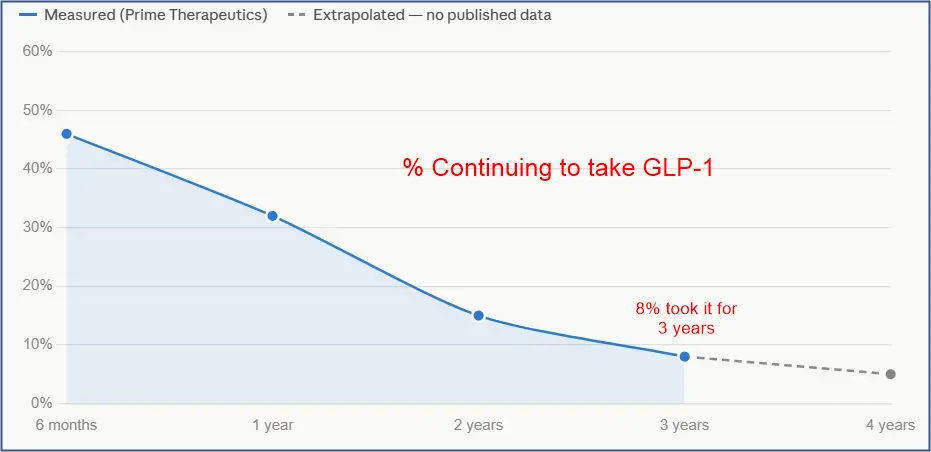
Here's the real-world data. The best consistent series comes from Prime Therapeutics, tracking ~5,780 commercially insured adults with obesity but without diabetes who started a GLP-1 in 2021–early 2022 (persistence = no gap over 60 days).The numbers behind it:
| Time point | Still on therapy | Source |
|---|---|---|
| 6 months | 46% | Prime: overall persistence 46.3% at 180 days |
| 1 year | 32% | 32.3% at 1 year |
| 2 years | 15% | follow-up study found 15% at two years |
| 3 years | 8% | only 8.1% persisted the full three years |
| 4 years | no data | — |
Three caveats worth knowing before you use this:
Drug matters a lot. Weekly semaglutide had the highest three-year persistence at 14.3%; daily liraglutide (Victoza) the lowest at 2.5%. The 8% is an average across a mix dominated by older, weaker products.
This cohort started in 2021–early 2022, during the shortages. Newer starters are doing much better: 1-year persistence to high-potency weight-loss GLP-1s nearly doubled from 33% in 2021 to 61% in the first half of 2024. If that first-year improvement carries forward, the long-tail numbers for today's initiators will be substantially higher than this curve.
"Persistence" is a claims definition, not a behavior. It means no gap over 60 days in insurance-billed fills — people may have kept taking the drug by buying outside their insurance benefit, such as purchasing directly. With compounded and cash-pay semaglutide widespread in 2023–2025, this likely undercounts real use by a meaningful margin.
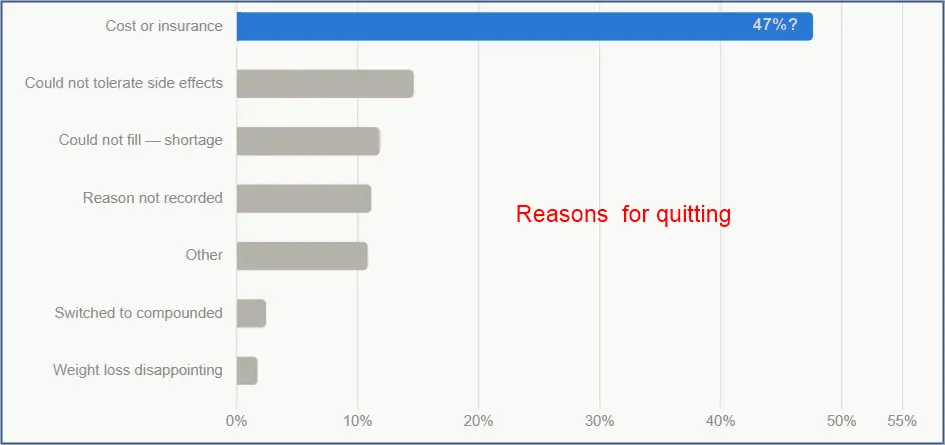
Main Reasons for quitting: cost or insurance stopped
ClaudeAI
Cost dominates — by a lot more than most people assume. The best data is a Cleveland Clinic study that pulled actual chart notes for 288 randomly selected adults with obesity but without type 2 diabetes who started injectable semaglutide or tirzepatide and quit within the first year, so the reason is what the clinician recorded, not what a survey respondent recalled.The exact figures: 137 patients (47.6%) stopped over cost or insurance, 42 (14.6%) because they couldn't tolerate side effects, 34 (11.8%) because shortages meant they couldn't fill it, 7 (2.4%) switched to a compounded version, 5 (1.7%) over unsatisfactory weight loss, 31 (10.8%) for other reasons, and 32 (11.1%) had no reason recorded.
Note that "cost" is a broader bucket than sticker price — it includes insurance denial, a discount coupon expiring, and out-of-pocket cost simply being unaffordable. The coupon-expiry piece is why it hits later: cost was the top reason at every time point, but cost-driven quitters tended to stop later in treatment while side-effect quitters stopped earlier. So the steep first-3-month drop in the persistence curve is disproportionately GI intolerance; the long slow bleed after that is money.
But the picture flips depending on how you ask. Truveta's EHR analysis found side effects were the most commonly reported reason (28.2%), with cost a notable but smaller barrier at 12.8% — essentially the inverse of Cleveland Clinic's ordering. And in patient self-report surveys, side effects swamp everything: patients most often cited feeling sick (64.4%) and vomiting (45.4%), while among people still on therapy the top complaint excluding cost was simply preferring a pill to an injection (56% of patients versus 32.6% of physicians).
My read on the discrepancy: side effects are near-universally experienced and get volunteered readily, so they dominate any survey. But the thing that actually terminates therapy in the US is more often a coverage decision — and that reason gets recorded in a chart note while never showing up as a patient's stated grievance. The Cleveland Clinic authors were explicit about wanting to break the catch-22 where insurers decline coverage because people quit at high rates, when some of those people quit precisely because coverage was terminated or prior authorization failed.
Three things this list doesn't capture that likely matter:
- Dose escalation never happening. More than 80% of participants stayed on lower maintenance doses — which produces weaker results, which makes quitting rational. That shows up as "disappointing weight loss" or nothing at all.
- People treating it as a course rather than chronic therapy — the framing problem, where hitting a goal weight reads as "done."
- Muscle loss concerns, which are getting more attention now: trials have reported 35% to 45% of GLP-1 weight loss is lean mass including muscle and bone.
The shortage bucket (11.8%) should shrink or vanish in newer cohorts, which is part of why 1-year persistence roughly doubled by 2024.
Weight loss programs often regain lost fat, but only some of the lost muscle
CLAUDE AI
The regain isn't a drug problem; it's a weight-loss problem. Every modality shows it, and GLP-1s are actually mid-pack on durability, not worst.
| Modality | Typical loss | Regain pattern |
|---|---|---|
| Diet/lifestyle | ~7.4% average, generally regained within 4.1 years | Nadir ~6 months, then steady creep |
| GLP-1, stopped | 15–20% | ~60% regained at 1 year, then plateaus |
| Gastric bypass | ~30–38% at nadir | weight regain prevalence 27.8% at 7 years, range 14–37%; mean regain at 10 years 28% of maximum loss, with 56.7% classed as regainers |
The shape is the same everywhere: nadir at 6 months for lifestyle, ~1 year for surgery, then gradual regain — bypass patients hitting 38% total body loss at one year and settling near 25% below baseline at ten. Surgery is the most durable, but "durable" means keeping about two-thirds of the loss, not all of it.
On your composition question specifically — this is where it gets contested, and the argument is 80 years old.
Dulloo's reanalysis of the 1945 Minnesota Starvation Experiment found a disproportionately faster recovery of fat than lean mass during refeeding — "preferential catch-up fat" — and, strikingly, after body fat had fully returned to pre-starvation levels there was still a fat-free mass deficit, and hyperphagia persisted until FFM was completely recovered; because lean tissue can only be regained alongside fat, more body fat ended up regained than was lost. He calls this "collateral fattening" and the resulting fat overshoot. The mechanism requires two things: a feedback loop where lean deficit drives hunger, and a temporal desynchronization where fat recovery finishes before lean recovery. Dulloo attributes part of the asymmetry to suppressed thermogenesis persisting into the regain phase, and explicitly frames the endpoint as a risk for sarcopenic obesity. The pattern isn't diet-specific — preferential catch-up fat is documented after weight loss from malnutrition, cancer, septic shock, and AIDS.
But the population-level evidence pushes back hard. A 2024 systematic review of 23 studies concluded the overwhelming majority of evidence suggests weight cycling is not associated with adverse effects on body weight, body composition, or metabolic rate, and that people should not be discouraged from repeated weight-loss attempts. A Lancet Diabetes & Endocrinology review this May went further: studies that objectively track body composition show no consistent evidence that weight cycling causes disproportionate loss of lean mass or long-term suppression of metabolic rate; weight regain reverses the benefits of weight loss but does not worsen baseline health status. The cross-sectional literature splits about down the middle — 58% (11 of 19) of publications found weight-cycling history correlated with increased body fat and central adiposity, but the reviewers judged the evidence on body composition inconclusive.
My read on how to reconcile these: Dulloo is describing a real transient asymmetry during the regain window — fat comes back first, lean lags — measured with tight metabolic-ward control after severe depletion. The skeptics are asking a different question: after the cycle completes, are cyclers measurably fatter than non-cyclers? And there the answer is mostly no. Those aren't contradictory. The asymmetry can be real and still resolve, given time and adequate protein and loading. That's also why the caveat keeps appearing that outcomes hold up particularly when resistance training is maintained.
Where GLP-1s might genuinely differ from a diet: the appetite suppression that makes protein intake and dose-escalated loss easy on the way down disappears abruptly on the way up, and newer agents like semaglutide and tirzepatide appear less effective at preserving lean mass than older ones. Whether that produces a worse composition outcome than an equivalent diet-induced loss is, as far as I can tell, untested — same gap as before. The single most actionable thing in this literature is that resistance training and protein during both phases is the intervention everyone agrees on, and it's the one thing under the individual's control regardless of modality.