
Calcium and Vitamin D for a year before knee replacement cut revisions by a third
Impact of Vitamin D Concentration on Postoperative Outcomes and Complications Following Total Knee Arthroplasty: A Scoping Review of the Literature
Nutrients, 5 June 2026, https://doi.org/10.3390/nu18111828
Daniel Jaglarz, Tomasz Strzemecki, Rafał Pankowski, Nina Janowska, Piotr Sypień, Ewa Tramś, Rafał Kamiński, Dariusz Grzelecki
Chart does not mention the non-bone benefits of vitamin D
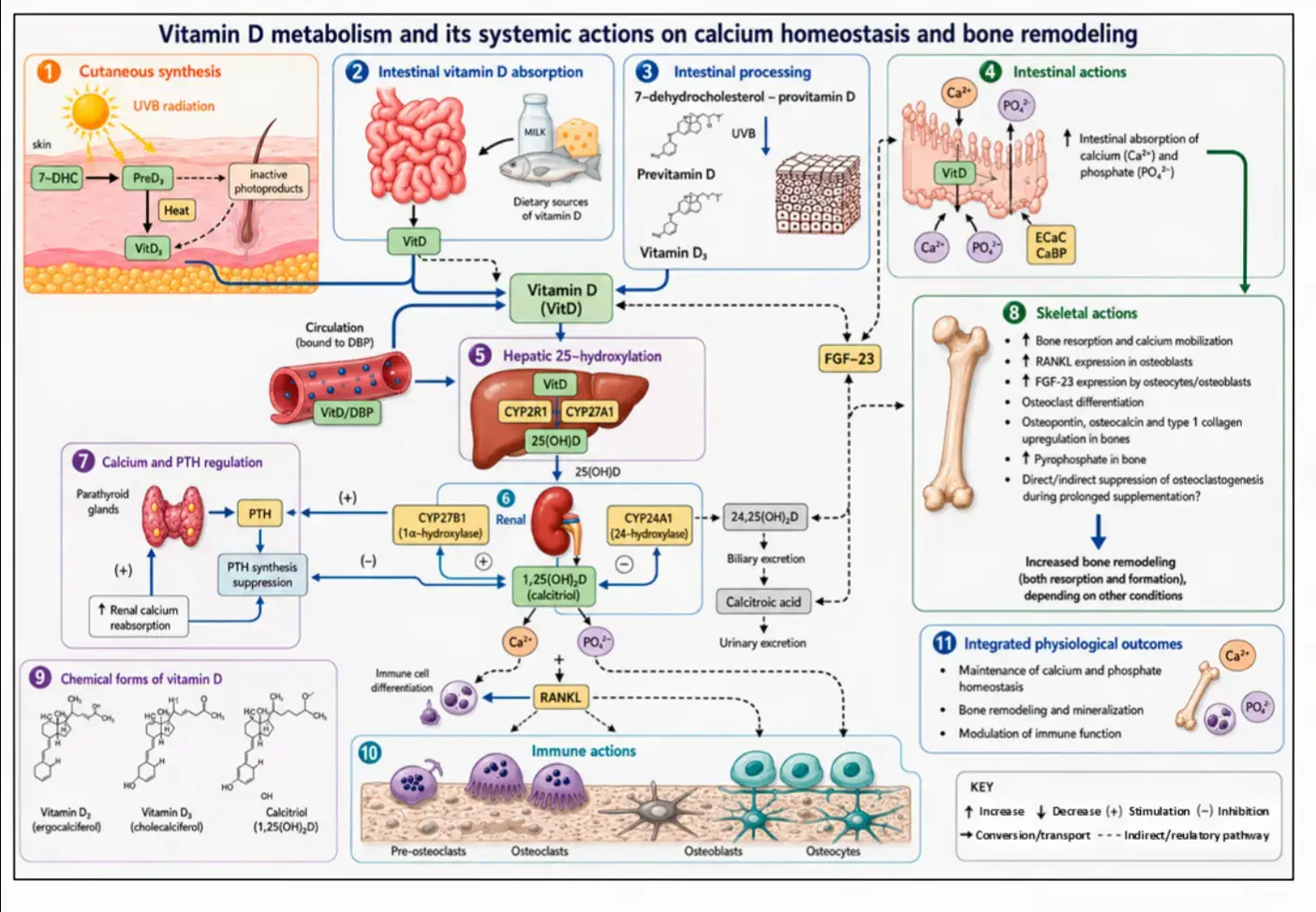
Summary by Claude - August, 2026
If you are scheduled for a knee replacement, getting your 25(OH)D tested and corrected months beforehand is cheap, low-risk, and may reduce your odds of a bad outcome. This is a scoping review — a structured tour of the literature, not a pooled analysis — covering 19 human studies published 2014–2024 in PubMed, Scopus and Web of Science.
Deficiency is very common in this population: 13% to 80% of knee replacement patients, depending on whether the study used a cutoff of 12, 20, or 30 ng/mL. Ten of 12 studies looking at complications found low vitamin D associated with worse results. The largest (6,593 knees, deficiency <20 ng/mL) reported higher odds of prosthesis explantation (OR 2.97), surgical site infection (OR 1.76), stiffness needing manipulation under anesthesia (OR 1.69), DVT (OR 1.80), and heart attack (OR 2.11). A Korean database study of 142,147 patients found that taking calcium plus vitamin D (800 IU or more daily) for over a year before surgery was associated with fewer revisions, both infected (aHR 0.63) and non-infected (aHR 0.70). Patients who develop a periprosthetic joint infection have markedly low levels — one German series averaged 13.3 ng/mL. Function scores (KSS, WOMAC) were worse in deficient patients in 6 of 9 studies, and one study found a 2- to 3-fold higher risk of persistent post-surgical pain.
The authors suggest 800–2,000 IU/day for insufficiency and 2,000–4,000 IU/day for confirmed deficiency, started at least 6–8 weeks before surgery, targeting above 30 ng/mL. One study showed weekly 50,000 IU corrected deficiency in 4–6 weeks.
What this does not show / limitations
- Almost all of the evidence is observational, so causation is not established — low vitamin D also marks obesity, immobility, poor nutrition and general ill health, any of which could drive the complications on its own.
- The supplementation results are mixed and mostly negative: a randomized trial giving 50,000 IU on the day of surgery found no difference in function or complications, and a 300,000 IU pre-op loading study cut wound infections and cellulitis but left periprosthetic joint infection rates unchanged.
- The one apparently large benefit came from a year of daily calcium plus D — a duration no trial has tested head-to-head.
No formal quality assessment of the included studies was done, no data were pooled, and deficiency cutoffs ranged from 12 to 30 ng/mL, which the authors concede makes the studies hard to compare. Notably, the abstract's claim of "up to a 2-fold increase" in revision for infection overstates the source: in that study, tibial/femoral revision at one year was not significant (OR 1.26, p = 0.28) — the significant finding was implant explantation. No achieved 25(OH)D levels are reported for most of the supplementation studies, so we do not know what blood level, if any, is protective.
The review is defensible but the data extraction is sloppy:
- Table 2 contains two duplicated rows under wrong author names. The "Shin et al. [20], USA, 6593" row is actually Hegde et al. [33] data (it repeats verbatim further down). The "Maniar et al. [21], Germany, 109" row is actually Maier et al. [32] data. So the "12 complication studies" is realistically 10.
- Reference range mismatch. Results says 19 studies "[14–32]" but the included studies are cited as [16]–[34].
- Impossible numbers in the Jansen description (p. 15): sufficient group median 26 ng/mL and insufficient group median 32 ng/mL with a range of 2.4–16. The medians are swapped or garbled.
- Weintraub RCT is misdescribed on p. 14 as confirming supplementation "can reduce the incidence of postoperative complications and accelerate patient recovery, but there was no statistical significance." It was null; that sentence should not survive into a summary.
- Name typos throughout: Mainar/Maniar, Kahn/Khan, Jensen/Jansen, Hedge/Hegde, "Darius fracture" for distal radius fracture.
Related in VitaminDWiki
- Total knee arthroplasty – worse outcome if low vitamin D – many studies
- Total Hip or Knee Arthroplasty: 4 more days in hospital if low Vitamin D
- 400,000 IU of Vitamin D before surgery should cost-effectively reduce infection after knee replacement
- Surgery complications cut in half by 300,000 IU of vitamin D 2 weeks before (hip and knee) – RCT
not have to wait a year - Knee osteoarthritis pain reduced by 60,000 IU monthly vitamin D following loading dose – RCT
- 4 fewer days in hospital after hip or knee replacement if good level of vitamin D
- Probability of knee osteoarthritis up 50 percent if 20 ng less vitamin D
Perhaps prevent the surgery
Many surgeries benefit for Vitamin D
Bones need more than just Vitamin D