
ADHD shortens longevity by 9 years, increases many risks, Vitamin D can help
Life expectancy and years of life lost for adults with diagnosed ADHD in the UK: matched cohort study
The British Journal of Psychiatry Jan 2026 https://doi.org/10.1192/bjp.2024.199
Background Nearly 3% of adults have attention-deficit and hyperactivity disorder (ADHD), although in the UK, most are undiagnosed. Adults with ADHD on average experience poorer educational and employment outcomes, worse physical and mental health and are more likely to die prematurely. No studies have yet used mortality data to examine the life expectancy deficit experienced by adults with diagnosed ADHD in the UK or worldwide.
Aims This study used the life-table method to calculate the life-expectancy deficit for people with diagnosed ADHD using data from UK primary care.
Method A matched cohort study using prospectively collected primary care data (792 general practices, 9 561 450 people contributing eligible person-time from 2000–2019). We identified 30 039 people aged 18+ with diagnosed ADHD, plus a comparison group of 300 390 participants matched (1:10) by age, sex and primary care practice. We used Poisson regression to estimate age-specific mortality rates, and life tables to estimate life expectancy for people aged 18+ with diagnosed ADHD.
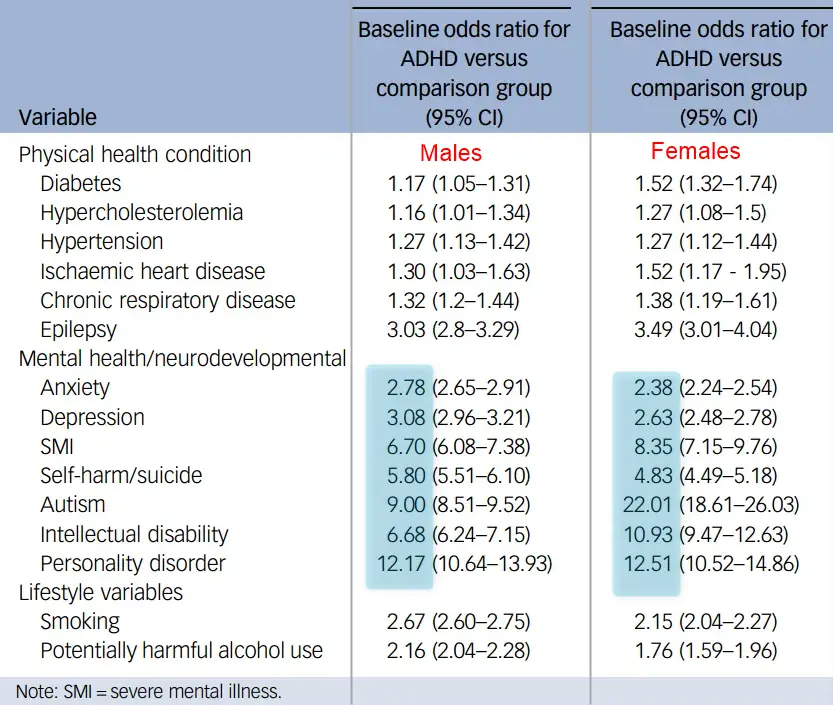
Results Around 0.32% of adults in the cohort had an ADHD diagnosis, ~1 in 9 of all adults with ADHD. Diagnoses of common physical and mental health conditions were more common in adults with diagnosed ADHD than the comparison group. The apparent reduction in life expectancy for adults with diagnosed ADHD relative to the general population was 6.78 years (95% CI: 4.50 to 9.11) for males, and 8.64 years (95% CI: 6.55 to 10.91) for females.
Conclusions Adults with diagnosed ADHD are living shorter lives than they should. We believe that this is likely caused by modifiable risk factors and unmet support and treatment needs in terms of both ADHD and co-occurring mental and physical health conditions. This study included data from adults with diagnosed ADHD; the results may not generalise to the entire population of adults with ADHD, the vast majority of whom are undiagnosed.
Reported in: ADHD’s Sobering Life-Expectancy Numbers
" ADHD is linked with a lifespan that’s nearly seven years shorter for men, and about nine years shorter for women."
"No one dies from ADHD itself. Rather, symptoms such as concentration issues, emotional instability, memory issues, and impulsivity can touch nearly every aspect of life.
- Researchers have long known that people with ADHD are more likely to engage in risky behaviors, including substance abuse, unsafe sex, gambling, criminal acts, and dangerous driving.
- They are at a higher risk of depression, anxiety, and suicide. Difficulties keeping up with healthy lifestyle habits, such as eating well and exercising, lead to higher rates of obesity. All of these risks can chip away at a person’s life: Around the world, having ADHD is associated with lower socioeconomic status."
- "The earlier a person knows about their disorder and the risks associated with it, the better. In a way, ADHD is like diabetes, Goodman said. When it’s treated early, living a relatively healthy life is doable. The longer it isn’t treated, the more the comorbidities pile up: heart disease, vision problems, nerve damage, kidney disease, and so on. With ADHD and diabetes, treatment can involve both drugs and lifestyle changes."
Related in VitaminDWiki
-
ADHD children have much lower levels of vitamin D
ADHD is more likely if low vitamin D in early pregnancy
Less sun is associated with more ADHD (season and latitude)
- The ADHD rate has increased a lot in the past few decades - especially for adults
- Vitamin D levels have dropped a lot in the past few decades
- There are many positive observational studies of Vitamin D and ADHD
- ADHD shares risk factors with Autism and many other diseases:
- Low Vitamin D, Low Omega-3, Low Magnesium, Low UVB (= high latitude or winter)
- ADHD has been treated by each of Vitamin D, Omega-3, Magnesium, and Zinc
Attention-Deficit-Hyperactivity Disorder increasing (2.7X in US Blacks under age 18 in 20 years)
Prevent while pregnant
ADHD 1.5X less likely if 4,400 IU Vitamin D daily during pregnancy - RCT
ADHD 4.9 X higher risk if less than 12 ng of vitamin D during early pregnancy
- Incidence Autism and ADHD reduced 18 percent per 10 ng of Vitamin D during pregnancy – meta-analysis
Treat with vitamin D
- Vitamin D patented to treat ADHD
- Children with ADHD again helped by 50,000 IU weekly Vitamin D – RCT
- ADHD in Arab countries – vitamin D is the only changeable risk factor – review
Longevity, Healthspan