
Alpha-gal syndrome from ticks ==> 98X increase in red meat allergy in a decade - May 2026
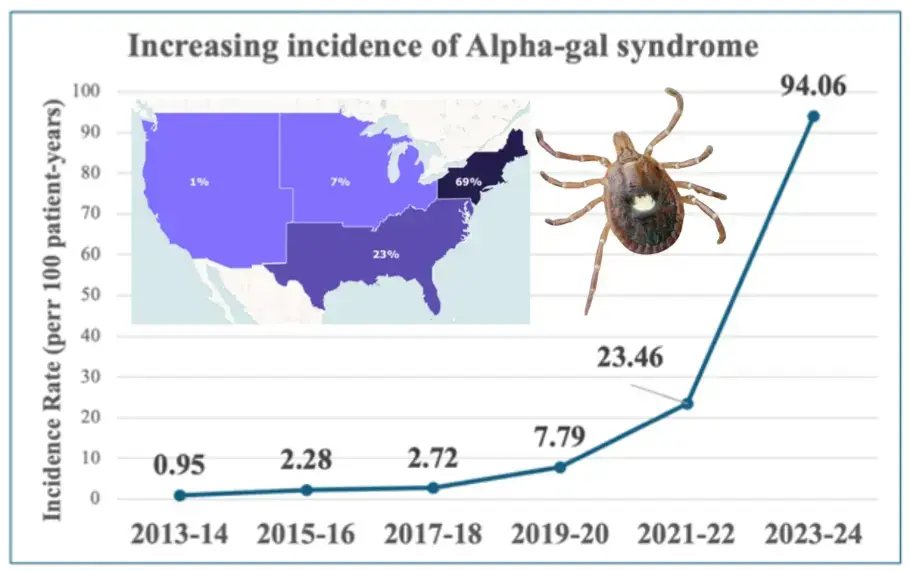
Tick-Borne Alpha-Gal Syndrome Incidence Skyrocketed 9,800% in the U.S. Since 2013
Claude AI on Ticks and Alpha-Gal
Alpha-gal syndrome (AGS) is a delayed allergic reaction to galactose-α-1,3-galactose, a sugar molecule present in the meat and products of most mammals (beef, pork, lamb, venison, and often dairy and gelatin) but absent in humans and Old World primates. What makes it unusual is the trigger: it isn't a pathogen the tick carries, but a sensitizing reaction to the alpha-gal molecule itself, transferred via tick saliva. A tick bite triggers an immune reaction to the sugar molecule galactose-α-1,3-galactose. In the U.S. the main culprit is the lone star tick (Amblyomma americanum), though several other species drive AGS elsewhere — Ixodes ricinus in Europe, I. holocyclus in Australia, Haemaphysalis longicornis in Asia.
The hallmark is its delayed presentation, which makes it notoriously hard to diagnose:
a tick bite in summer can lead, months later, to
- hives,
- gastrointestinal distress, or
- even life-threatening anaphylaxis hours after eating a hamburger or steak.
That delay between eating mammalian meat and the reaction (often 2–6 hours) is unlike most food allergies.
On the recent increase, the headline figure comes from a VCU study presented at the American College of Gastroenterology's 2025 meeting. It showed a 100-fold increase in positive test results for alpha-gal antibodies between 2013 and 2024. One researcher framed it as having gone from a medical curiosity to a major public health issue in just a decade, and that this is no longer a localized problem.
The CDC now suspects up to 450,000 people in the U.S. may be affected.
Two things worth flagging on the magnitude, since they bear on how to interpret these numbers:
The geographic spread is real and documented. The lone star tick has expanded well beyond its historic Southeastern range. Long Island — particularly Suffolk County — has emerged as an unexpected hotspot, with the CDC estimating between 3,800 and 18,000 people there had alpha-gal from 2010 to 2022, as much as 1.2% of the population.
Some of the increase is a result of increased awareness
But the size of the "increase" partly reflects measurement, not just biology. As one clinician put it candidly, the rise based on positive diagnoses may simply reflect growing awareness and testing — AGS was only identified in 2008, so the early baseline was near zero and clinicians weren't testing. A separate infodemiology study captures this awareness curve well: from 2015 to 2022 the estimated overall change in search volume for "alpha-gal" was 627%, far outpacing searches for "lone star tick" or "meat allergy."
That said, there's biological evidence the underlying risk is genuinely elevated, not purely an artifact. A 2023 case-control study found an 11-fold increased risk of AGS in people reporting tick bites. And there's an intriguing mechanistic wrinkle: the tick-borne pathogen Anaplasma phagocytophilum increases the level of tick α-Gal, potentially raising the risk of developing AGS after a bite by an infected tick.
One note of caution on sourcing: the much larger "5,566% in ten years" figure circulating in some outlets (including the kind of post you may have read) appears alongside speculative biowarfare framing about tick research history. The defensible, peer-reviewed number is the ~100-fold (≈10,000% over a longer/different window and metric) rise in positive tests, which isn't the same as confirmed clinical incidence. The honest summary is that AGS is genuinely spreading geographically and rising in detected cases, but a meaningful share of the dramatic percentages reflects a near-zero starting baseline plus a rapid catch-up in awareness and testing.
Tick-Borne Alpha-Gal Syndrome Skyrocketed 10,000% as Bill Gates Spent $7.6 Million Developing GMO Ticks Designed to Spread in the Wild - May 2026
2025 article in the Journal Bioethics wonders if ticks should be encouraged
Beneficial Bloodsucking PDF behind paywall * . . ." we argue that if eating meat is morally impermissible, then efforts to prevent the spread of tick-borne AGS are also morally impermissible. " * . . ."we argue that tickborne AGS is a moral bioenhancer if and when it motivates people to stop eating meat."
Dr. Cole interview on AGS - May 2026
- "The conversation covers why symptoms often appear hours after eating, how repeated tick bites can intensify the reaction, and why the condition is becoming more common as the lone star tick expands its range across the United States. Dr. Cole notes that up to two-thirds of patients see improvement over time, and walks through practical prevention steps for anyone spending time outdoors this season."
- "It’s known as the midnight allergy because it’s usually a couple hours after you eat—two to six hours—and 12 o’clock at night, midnight, all of a sudden you’re developing hives, itchiness, may get some swelling of the lips, the gums, the tongue, and in rare cases you can get anaphylaxis, but it can lead to really uncomfortable GI upset."
- "Millions of people get tick bites, only a handful of ticks are going to carry this, but take precautions. Use some of the sprays that will prevent ticks."
- " The good news is a good percentage of people—I would say up to two thirds—over time, the allergy will lessen"
- "Just a little aside, you’ve got to also be careful of gelatin, marshmallows, certain medication capsules that carry gelatin, because those are derived from beef products. "
Related in VitaminDWiki
- Tick disorders associated with Vitamin D - several studies
- Tick disorder reduced by Vitamin D supplementation
- Some people with AGS think that they are allergic to lanolin-derived vitamin D are probably allergic to the gel capsules.
Halal-approved capsules are not made from gelatine - Lyme disease and Vitamin D Receptor - many studies- also from ticks, 4X increase in 29 years
Food Allergies
- Food allergies associated with low Vitamin D - many studies
- Allergic reactions to Insect sting decreased by topical Vitamin D (frequent)
wonder if topical vitamin D on tick bite might reduce allergic reaction - Food allergies are associated with Vitamin D thru genes, etc.