T cells (which need Vitamin D) have won 5 Nobel Prizes
T cell Nobel Prizes: 1960, 1980, 1996, 2011, 2015
| Year | Nobel laureates | What they discovered | Connection to T cells |
|---|---|---|---|
| 1960 | Frank Macfarlane Burnet & Peter Medawar | Acquired immunological tolerance | Foundational work underlying understanding of T-cell tolerance |
| 1980 | Baruj Benacerraf, George D. Snell & Jean Dausset | Genetic control of immune responses; major histocompatibility complex (MHC) | Very important for T-cell recognition |
| 1996 | Peter Doherty & Rolf Zinkernagel | How T cells recognize virus-infected cells together with MHC molecules | Directly about T-cell function |
| 2011 | Bruce Beutler, Jules Hoffmann & Ralph Steinman | Innate immunity and dendritic cells | Dendritic cells are crucial for activating T cells |
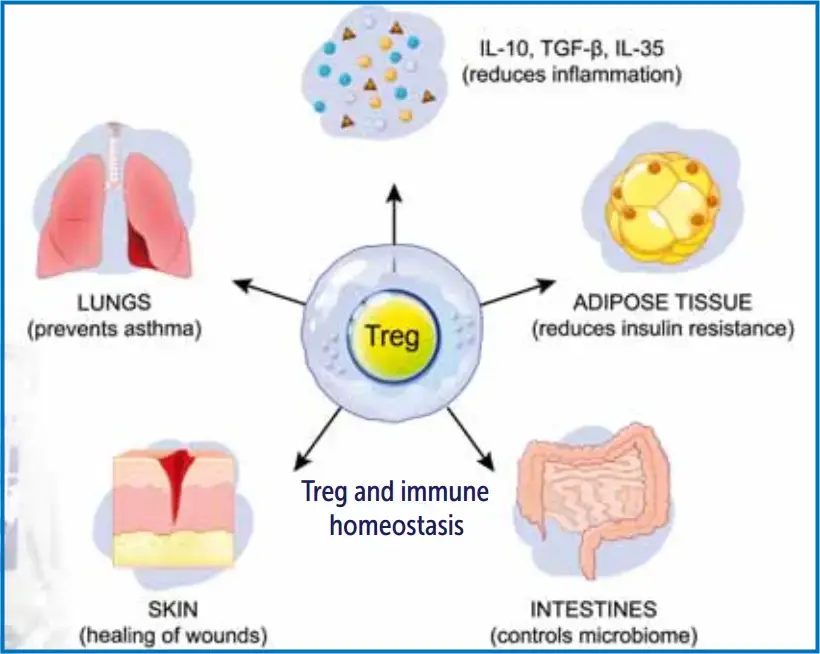
| 2025 | Mary Brunkow, Fred Ramsdell & Shimon Sakaguchi | Regulatory T cells and peripheral immune tolerance | Directly about Tregs |
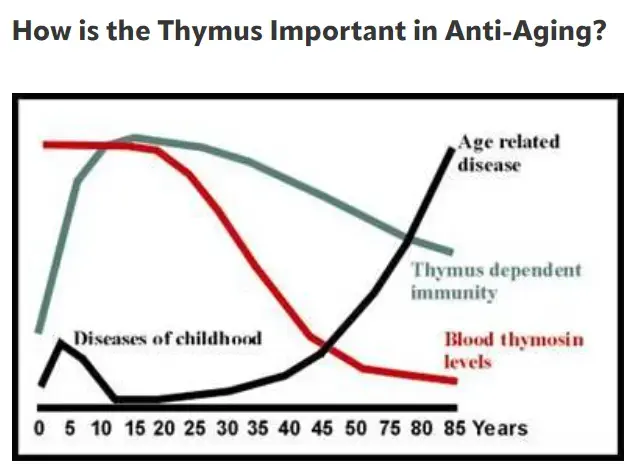
Thymus involution (aging)
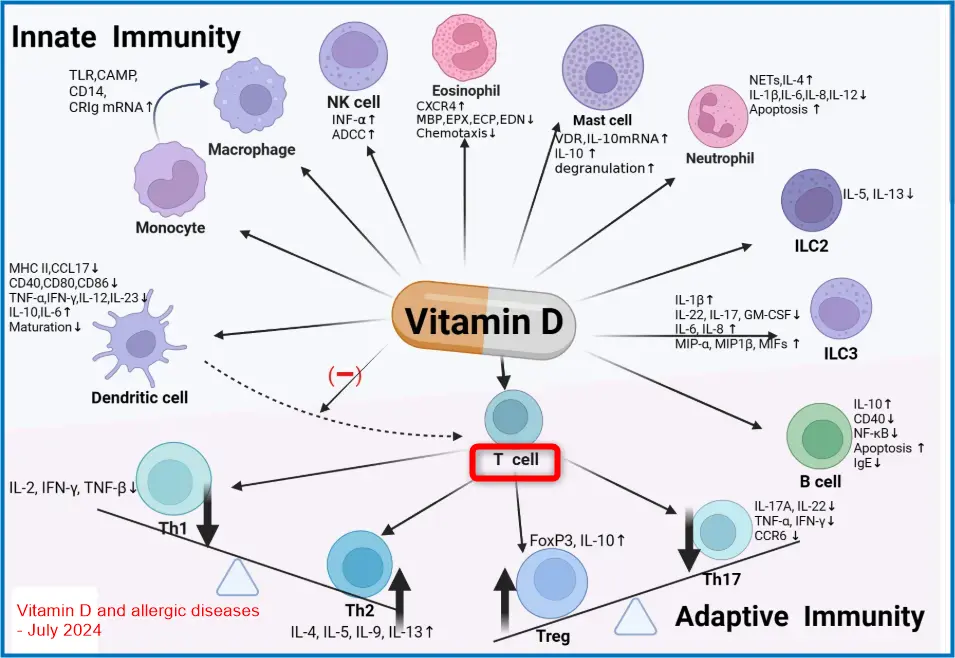
Cells in innate and adaptive immunity
Related in VitaminDWiki
- T-cells need at least 40-50 ng of Vitamin D to fight COVID-19
- Fight Cancer with more than cut, burn, and poison – Nobel prize for T-Cell
- Vitamin D improves T Cell immunity – RCT
- The vitamin D receptor and T cell function
- Covid-19, T cells, and Vitamin D
- Adults with a healthier thymus had a 50 % lower risk of death
- T-cells increased with monthly doses of 140,000 IU vitamin D
- Vitamin D helps T-cell and immune system – overview
T cell Life cycle - Google AI Aug 2026
The T cell life cycle starts when stem cells in the Bone Marrow produce immature precursors that travel to the thymus. In the thymus, they mature through rigorous selection steps, enter the bloodstream as naive cells, activate when facing an infection, and eventually transform into memory or dying cells.
Origin and Maturation
- Bone Marrow Production: Stem cells make early T cell precursors.
- Thymus Migration: Precursors move to the thymus gland to develop.
- Positive Selection: Cells learn to recognize the body's own marker proteins (MHC).
- Negative Selection: Cells that attack the body's healthy tissues are destroyed.
Circulation and Activation
- Naive State: Mature T cells leave the thymus and wait in the lymph nodes or blood.
- Antigen Encounter: An infected cell or dendritic cell presents a germ or virus piece.
- Activation: The T cell wakes up, multiplies fast, and turns into an active worker cell (helper or killer cell).
Response and Decline
- Immune Action: Killer T cells destroy infected cells, while helper T cells direct other immune parts.
- Contractile Phase: Most active T cells die off via programmed cell death once the threat is gone.
- Memory Transition: A small group survives long-term as memory T cells to guard against future infections.
T cell originate in bone marrow, Thymus selection - Claude AI - Aug 2026
T cells originate in the bone marrow, like all blood cells, from hematopoietic stem cells. Immature progenitors then migrate through the bloodstream to the thymus, where they actually mature into functional T cells. That's where the "T" comes from.
The thymus is where the important selection happens:
- Positive selection — cells that can recognize the body's MHC molecules survive; those that can't die off
- Negative selection — cells that react too strongly to the body's own proteins get eliminated, which prevents autoimmunity
Roughly 95%+ of developing thymocytes die during this process. Only the survivors exit as naive CD4+ or CD8+ T cells and circulate to the lymph nodes and spleen.
One quirk worth knowing: the thymus is most active in childhood and then progressively shrinks and gets replaced by fat (thymic involution), starting around puberty. By later life it produces very few new T cells, and you largely maintain your T cell population by proliferating the ones you already have. That's part of why immune responses to novel pathogens weaken with age — the existing repertoire is still there, but the supply of fresh, differently-shaped receptors has dwindled.
IMMUNE Regulatory T Cells: A Nobel-Winning Revolution in Medicine
📄 Life Extension Foundation - Sept 2026 - PDF