
South Koreans supplementing with Vitamin D increased from 44% to 66% in a decade
Upward changes in serum 25-hydroxyvitamin D levels in South Korea: the Korea National Health and Nutrition Examination Survey studies IX (2022–2023) versus VI (2013–2014)
Osteoporosis and Sarcopenia (Elsevier / Korean Society of Osteoporosis), August 2026, https://doi.org/10.1016/j.afos.2026.08.002
Ju-Hyun Park, Na-Hyeon Lee, Yoon-Sok Chung, Choon Hee Chung, Han Seok Choi
Summary by Claude - September, 2026
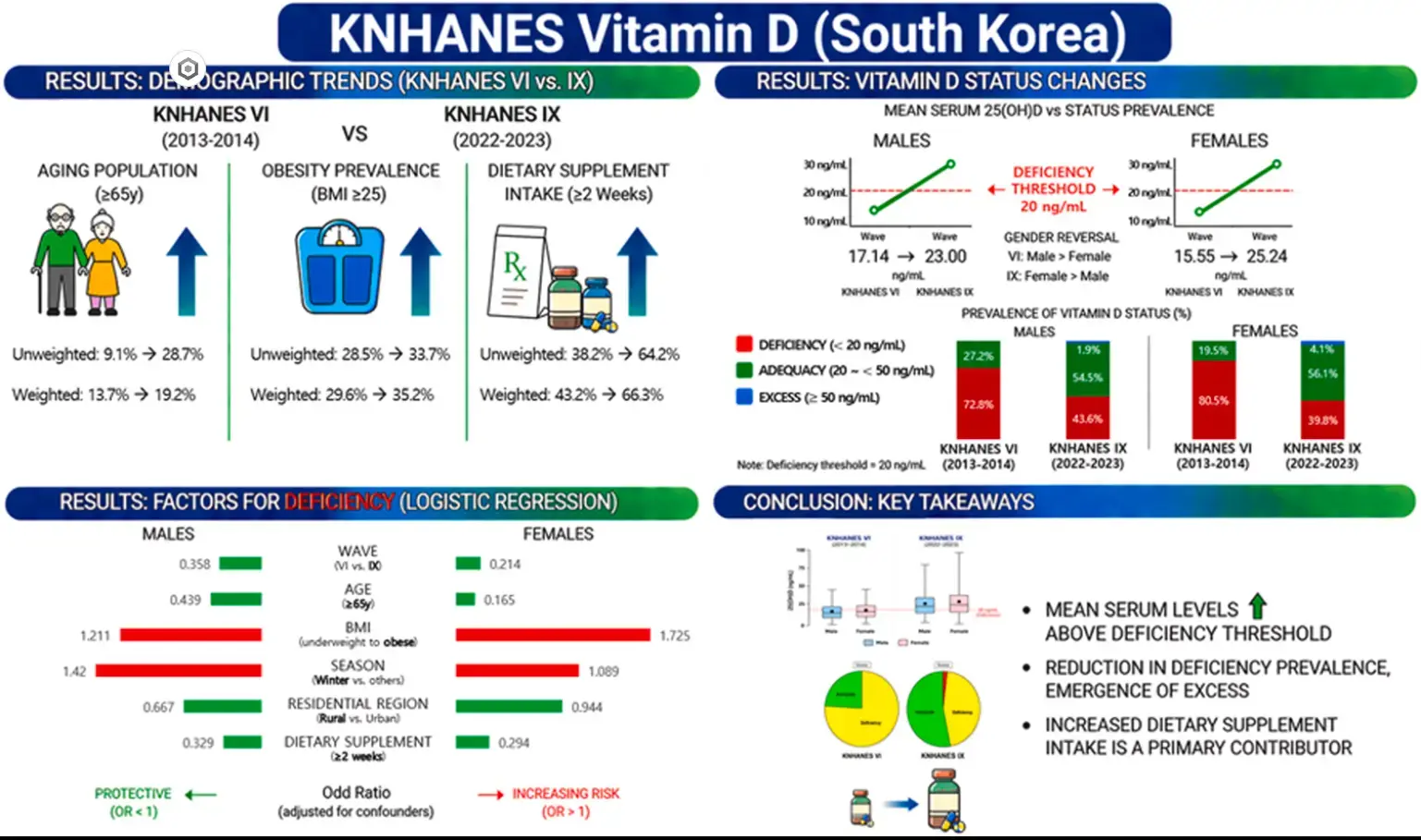
South Korea's vitamin D levels rose substantially over a single decade, and the strongest correlate was supplement use. This is a comparison of two waves of the national KNHANES survey — 4,704 people in 2013–2014 and 11,744 in 2022–2023, 16,448 total, weighted to represent the whole country.
Mean serum 25(OH)D climbed from 17.1 to 23.0 ng/mL in men and from 15.6 to 25.2 ng/mL in women — women overtook men. Deficiency (<20 ng/mL) fell from 72.8% to 43.6% in men and from 80.5% to 39.8% in women. Adjusted odds of deficiency in the later wave were 0.358 for men and 0.214 for women. A group above 50 ng/mL appeared for the first time (1.9% of men, 4.1% of women); it was essentially nonexistent in 2013.
Supplement use (any dietary supplement, ≥2 weeks/year) rose from 43.2% to 66.3% and was the most consistent protective factor: OR 0.329 men, 0.294 women. Users averaged 25.5–27.7 ng/mL versus 18.9–19.0 for non-users. Women aged 65+ did best at 31.0 ng/mL; men aged 20–34 were worst (OR 1.825). Obesity raised deficiency risk in women only (OR 1.725). Winter still hurt men (OR 1.420).
What this does not show:
No doses were recorded, and the supplement question did not identify vitamin D specifically — so this cannot tell you what intake produced these levels. Cross-sectional, so no causation.
The big caveat is that the assay changed between waves (RIA → LC-MS/MS) with no cross-calibration; the authors say the relative contributions "cannot be quantified." A separate 2013 Korean LC-MS/MS dataset (20.6 ng/mL overall) sits between the two waves, which argues the rise is real but not the whole story. Sun exposure and outdoor activity were never collected.
Related in VitaminDWiki
- Vitamin D levels INCREASED in Korea during lockdown (supplementation)
Some of the increase D was due to wanting to prevent COVID - 9X increase in Koreans seeking help with vitamin D deficiency in just 4 years
2015 - Huge differences between Vitamin D test results: CLIA, LC-MS, and home
Much of the increase in S. Korea is probably solely due to a change in the testers used.
Example: Blood tested on RIA as 18 ng could easily be 25 ng on LC-MS/MS
Summary of Claude AI on differences between vitamin D testers