
Preterm birth rate reduced 60% by Vitamin D (40 ng)
Maternal 25(OH)D concentrations >40 ng/mL associated with 60% lower preterm birth risk among general obstetrical patients at an urban medical center
PLoS ONE 12(7): e0180483. https://doi.org/10.1371/journal.pone.0180483
1,064 pregnant women at Medical University of South Carolina 9/2015 to 12/2016 Typically prescribed 5,000 IU of vitamin D daily Without a loading dose, the Vitamin D levels probably took 3 months after conception to plateau (and provide a benefit) A second vitamin D test in the first portion of 2nd trimester was used to increase the dosing (half of the women had vitamin D levels < 39 ng) Suspect that much more than 5,000 IU would be needed to get most (say 97.5%) of the women > 40 ng Also: 80% lower risk of recurrent PTB with >40 ng/mL compare to those <20 ng/mL

📄 Download the PDF from VitaminDWiki
Sharon L. McDonnell1, Keith A. Baggerly2, Carole A. Baggerly1, Jennifer L. Aliano1, Christine B. French1 christine@grassrootshealth.org, Leo L. Baggerly1, Myla D. Ebeling3, Charles S. Rittenberg3, Christopher G. Goodier3, Julio F. Mateus Nino3, Rebecca J. Wineland3, Roger B. Newman3, Bruce W. Hollis3, Carol L. Wagner3
1 GrassrootsHealth, Encinitas, California, USA,
2 Department of Bioinformatics and Computational Biology, The University of Texas MD Anderson Cancer Center, Houston, Texas, USA
3 Medical University of South Carolina Children’s Hospital, Charleston, South Carolina, USA
Background
Given the high rate of preterm birth (PTB) nationwide and data from RCTs demonstrating risk reduction with vitamin D supplementation, the Medical University of South Carolina (MUSC) implemented a new standard of care for pregnant women to receive vitamin D testing and supplementation.
Objectives
To determine if the reported inverse relationship between maternal 25(OH)D and PTB risk could be replicated at MUSC, an urban medical center treating a large, diverse population.
Methods
Medical record data were obtained for pregnant patients aged 18-45 years between September 2015 and December 2016. During this time, a protocol that included 25(OH)D testing at first prenatal visit with recommended follow-up testing was initiated. Free vitamin D supplements were offered and the treatment goal was >40 ng/mL. PTB rates (<37 weeks) were calculated, and logistic regression and locally weighted regression (LOESS) were used to explore the association between 25(OH)D and PTB. Subgroup analyses were also conducted.
Results
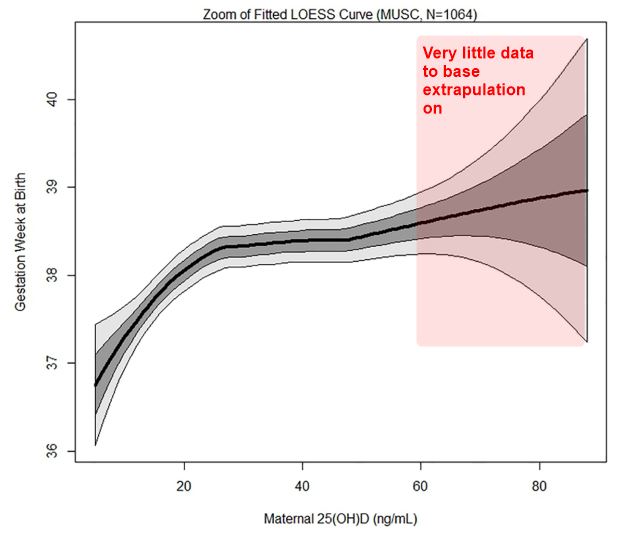
Among women with a live, singleton birth and at least one 25(OH)D test during pregnancy (N = 1,064), the overall PTB rate was 13%. The LOESS curve showed gestational age rising with increasing 25(OH)D. Women with 25(OH)D >40 ng/mL had a 62% lower risk of PTB compared to those <20 ng/mL (p<0.0001). After adjusting for socioeconomic variables, this lower risk remained (OR = 0.41, p = 0.002). Similar decreases in PTB risk were observed for PTB subtypes (spontaneous: 58%, p = 0.02; indicated: 61%, p = 0.006), by race/ethnicity (white: 65%, p = 0.03; non-white: 68%, p = 0.008), and among women with a prior PTB (80%, p = 0.02). Among women with initial 25(OH)D <40 ng/mL, PTB rates were 60% lower for those with >40 vs. <40 ng/mL on a follow-up test (p = 0.006); 38% for whites (p = 0.33) and 78% for non-whites (p = 0.01).
Conclusions
Maternal 25(OH)D concentrations >40 ng/mL were associated with substantial reduction in PTB risk in a large, diverse population of women.
Study summary
Claude AI
Preterm birth 60% lower when pregnancy vitamin D level was above 40 ng - observational Raising vitamin D above 40 ng during pregnancy cut preterm births in half, 80% if prior preterm birth - observational 1,064 pregnancies: 20% preterm birth if under 20 ng, 9% if over 40 ng - observational
Pregnant women whose blood level reached 40 ng/mL had roughly a 60% lower rate of preterm birth than women below 20 ng/mL — and the biggest benefit went to the women at highest risk.
This is an observational study of medical records, not a randomized trial: 1,064 women aged 18–45 with a single live birth at the Medical University of South Carolina between September 2015 and December 2016. During this period MUSC made vitamin D testing standard at the first prenatal visit, offered free 5,000 IU capsules with personalized dosing, and set a target of ≥40 ng/mL. Levels were measured by LC/MS.
Preterm birth (<37 weeks) rates by level closest to delivery: 20% under 20 ng/mL, 12% at 20–30, 13% at 30–40, and 9% at 40 ng/mL or above (trend p = 0.0003). Comparing ≥40 to <20 ng/mL gave a 62% lower risk (OR 0.38), still 59% after adjusting for insurance status and education — about 9 women treated to prevent one preterm birth. The reduction held for both spontaneous (58%) and medically indicated (61%) preterm births, and for both white (65%) and non-white (68%) women. Among the 140 women with a previous preterm birth, recurrence dropped 80% (42% down to 13%), an NNT of 3.
The most useful subgroup: among 344 women who started under 40 ng/mL at 20 weeks or earlier, those who got above 40 on a later test had a 6% preterm rate versus 16% for those who didn't — 60% lower (p = 0.006), and 78% lower among non-white women. Mean level among repeat-tested women rose from 24 to 39 ng/mL. No vitamin D toxicity: no serum calcium at or above 11 mg/dL.
What this does not show / limitations.
No randomization and no control group, so it cannot prove vitamin D caused the reduction — women who took supplements and returned for follow-up testing may differ in other ways that also protect against preterm birth. The primary analysis used the level closest to delivery, which is partly circular: a woman delivering at 30 weeks had less time to raise her level than one delivering at 39. Adjustment covered only two socioeconomic proxies — not BMI, smoking, or season. Nearly two-thirds of the women had only one test, blocking any trimester-by-trimester analysis. The 38% reduction among white women in the follow-up analysis was not statistically significant (p = 0.33). Several authors are from GrassrootsHealth, which advocates the 40 ng/mL target, and the supplements were donated by a manufacturer (both disclosed).
Related in VitaminDWiki
- Preterm birth and low Vitamin D - many studies
- Preterm births reduced in half if 40 ng of vitamin D in 3rd trimester
- Vitamin D intervention reduces preterm births and low birth weight by 60 percent – Cochrane Reviews – Nov 2017
- Low birth weight far more likely if African-American (low vitamin D) – 1997, Aug 2018
- Preterm birth 9 X more likely if fetus had a poor Vitamin D Receptor and previous miscarriage – Aug 2017
- Healthy pregnancies need lots of vitamin D