Parkinson's disease: none in Massia, who have the highest level of Vitamin D
From an email by Peter H Cobbold, May 2026
A natural human experiment in which the incidence of sPD is reduced 23-fold compared with developed nations has not been recognised. The Maasai tribe of Kenya/Tanzania is a population of pastoralist herders living a nomadic, entirely rural, traditional lifestyle. The Maasai have the lowest incidence world-wide of age-related sporadic Parkinson's disease. The incidence of PD in elderly Maasia is reported by Dekker as zero: https://www.nature.com/articles/s41531-023-00535. A door-to-door survey also revealed an exceptionally low age-matched incidence in Maasai , 23-FOLD lower than UK. https://movementdisorders.onlinelibrary.wiley.com/doi/abs/10.1002/mds.21898
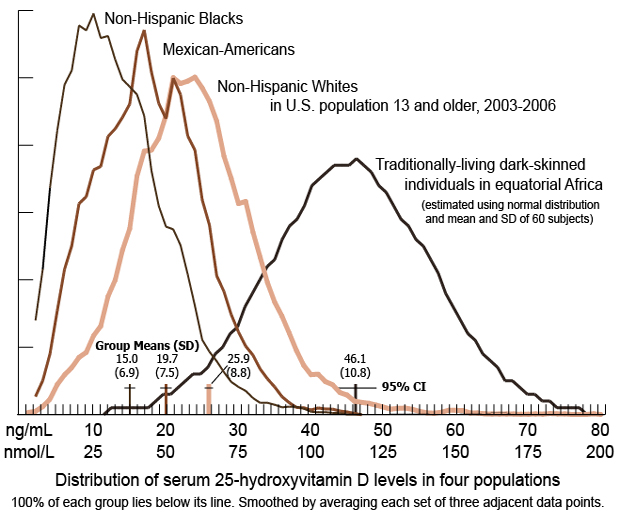
It is unlikely to be coincidental that the Maasia have the highest vitamin D status globally. The human ancestral level of serum 25(OH)D is regarded as being 100-150nmol/L on the basis of measurements made by Luxwolda et al on Maasai https://pubmed.ncbi.nlm.nih.gov/22264449/ Native Africans living in urban Nairobi have serum 25(OH)D 70 nmol/L and an incidence of sPD half that of UK and ca 10-fold higher than their Maasai relatives. The UK population mean is 70nmol/L at end-summer, falling to 50 at end-winter, and the elderly are lower. An extensive body of research, many thousands of papers, shows that vitamin D, the 'sunshine vitamin', acts epigenetically to control expression of several hundred genes , around 15% of our total, that have broad defensive functions: anti-inflammation, anti-oxidant, anti-microbial, calcium regulation, microglial phenotype, inflammasome suppression, etc etc. It is a reasonable conclusion that a D3 status of 100-150nmol/L prevents sporadic Parkinson's disease and that the key overarching environmental factor driving sPD globally is heliophobicity in its various forms (cosmetic, behavioral, dress codes, heat avoidance,urban aerial pollution absorbing UVB). These three papers, along with the highly pleiotropic epigenetic regulatory actions of D3, point to highly complex, preventive mechanisms co-ordinated across hundreds of genes by D3 signalling, the product of 400 million years' evolution.
The near-elimination of sPD by D3 is conceptually more important to understanding the etiology of sPD than factors that increase risk of sPD, on the basis that entropic arguments favor facile disruption over maintenance of the low entropy state. Thus, the pesticide-as-causal hypothesis requires evaluation in the context of the global population being physiologically D3-deficient. The question of whether D3 supplementation will reduce the progression of established PD is open. There is emerging evidence that lDOPA is subjected to D3-promoted xenobiotic defenses (e.g., CYP3A4, COMT) and that putative drug targets (e.g., NLRP) are suppressed by D3. Hundreds of putative drug targets should be evaluated for D3-regulation. In particular, the synuclein hypothesis should be examined for evidence why it does not become toxic, or monomers depleted, by D3 signaling. Indeed,to speculate, monomeric alpha-synuclein has anti-viral properties that resemble cathelicidin (LL37) and other anti-microbial peptides of the innate immune system. Expression of innate immune AMPs is promoted by D3. It is conceivable that,when production of innate AMPs is impaired by D3-deficiency, monomeric alpha-synuclein assumes an anti-viral role in the brain. The importance of those three papers cannot be overstated, for the first time we have a natural experiment displaying an intervention against sPD that is extraordinarily effective.
Related in VitaminDWiki