
Microplastics in Artery Plaque Predict a 4.5X Higher Risk of Heart Attack, Stroke, or Death
Why these 2 studies are on VitaminDWiki
Stroke and cardiovascular disease are both conditions where vitamin D status matters, and microplastics appear to act through inflammation, oxidative stress, and endothelial damage - the same pathways vitamin D moderates. Whether vitamin D actually blunts microplastic toxicity in humans has not been tested. See Microplastics causing problems in humans, etc. (Vitamin D can help) - many studies
Microplastics and Nanoplastics in Atheromas and Cardiovascular Events March 2024
N Engl J Med 2024;390:900-910 DOI: 10.1056/NEJMoa2309822
Raffaele Marfella, M.D., Ph.D., Francesco Prattichizzo, Ph.D., Celestino Sardu, M.D., Ph.D., Gianluca Fulgenzi, Ph.D., Laura Graciotti, Ph.D., Tatiana Spadoni, Ph.D., Nunzia D’Onofrio, Ph.D., +35 , and Giuseppe Paolisso,
Background: Microplastics and nanoplastics (MNPs) are emerging as a potential risk factor for cardiovascular disease in preclinical studies. Direct evidence that this risk extends to humans is lacking.
Methods: We conducted a prospective, multicenter, observational study involving patients who were undergoing carotid endarterectomy for asymptomatic carotid artery disease. The excised carotid plaque specimens were analyzed for the presence of MNPs with the use of pyrolysis–gas chromatography–mass spectrometry, stable isotope analysis, and electron microscopy. Inflammatory biomarkers were assessed with enzyme-linked immunosorbent assay and immunohistochemical assay. The primary end point was a composite of myocardial infarction, stroke, or death from any cause among patients who had evidence of MNPs in plaque as compared with patients with plaque that showed no evidence of MNPs.
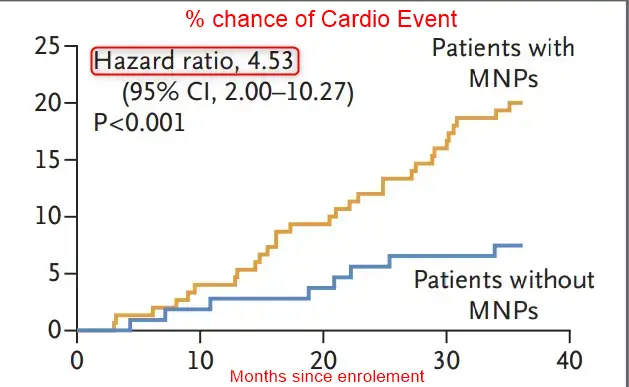
Results: A total of 304 patients were enrolled in the study, and 257 completed a mean (±SD) follow-up of 33.7±6.9 months. Polyethylene was detected in carotid artery plaque of 150 patients (58.4%), with a mean level of 21.7±24.5 μg per milligram of plaque; 31 patients (12.1%) also had measurable amounts of polyvinyl chloride, with a mean level of 5.2±2.4 μg per milligram of plaque. Electron microscopy revealed visible, jagged-edged foreign particles among plaque macrophages and scattered in the external debris. Radiographic examination showed that some of these particles included chlorine. Patients in whom MNPs were detected within the atheroma were at higher risk for a primary end-point event than those in whom these substances were not detected (hazard ratio, 4.53; 95% confidence interval, 2.00 to 10.27; P<0.001).
Conclusions: In this study, patients with carotid artery plaque in which MNPs were detected had a higher risk of a composite of myocardial infarction, stroke, or death from any cause at 34 months of follow-up than those in whom MNPs were not detected. (Funded by Programmi di Ricerca Scientifica di Rilevante Interesse Nazionale and others; ClinicalTrials.gov number, NCT05900947.)
Micro- and Nanoplastics as a Potential Risk Factor for Stroke: A Systematic Review
Journal of Xenobiotics (MDPI), February 14, 2026, https://doi.org/10.3390/jox16010034
Jakub Kufel, Miłosz Korbaś, Julita Janiec, Zofia Pankowska, Marta Młynek, Aleksandra Gaweł, Adam Mitręga
A second research group reached the same conclusion - and added a mechanism
Note: this is not independent confirmation of the 4.5X figure. The 4.53 hazard ratio in this review IS the Marfella NEJM study shown above - the same 257 patients, counted once. What this review adds that is new to this page is the thrombi work (plastics inside clots pulled from stroke patients) and three animal studies showing HOW plastic particles could damage the brain.
Summary by Claude - August, 2026
Plastic particles are turning up inside human arteries and blood clots, and the people who have them appear to fare much worse.
This is a systematic review of just 5 studies - 2 human observational studies covering 287 patients, and 3 rodent experiments. No pooled meta-analysis was done; the studies were too different, so the authors summarized them narratively.
The human findings:
- NEW: Microplastics were detected in 80% (24 of 30) of blood clots surgically removed from patients with ischemic stroke, heart attack, or deep vein thrombosis. Median concentration in stroke clots was 61.75 µg/g. Higher concentrations tracked with higher D-dimer, a marker of clotting activity.
- ALREADY ABOVE: In the 257 NEJM patients who completed follow-up, polyethylene was found in the plaque of 150 (58%) and PVC in 31 (12%). Over 34 months, those with plastic in their plaque had a hazard ratio of 4.53 (95% CI 2.00-10.27) for the combined outcome of heart attack, stroke, or death - after adjusting for the usual risk factors.
The animal studies supply a plausible mechanism. Larger microplastics get swallowed by immune cells, which then jam in brain capillaries and choke off blood flow. Smaller nanoplastics cross the blood-brain barrier outright. In rats, prior microplastic exposure made a later ischemic injury measurably worse - more dying neurons, more inflammation, poorer maze performance.
What this does not show / limitations
This does not show that plastic causes stroke. The authors say so plainly: the particles may be "markers of cumulative environmental exposure and disease severity rather than a direct causal factor." Note also:
- The 4.53 figure comes from ONE study, for a combined endpoint, not for stroke by itself. These reviewers rated that study high risk of bias, mainly for uncontrolled confounding such as smoking and socioeconomic status.
- Both human cohorts were surgical patients - already sick people, not the general population. Plastics have also been found in people with no stroke.
- All 3 animal studies used polystyrene, which is NOT the polymer found in human plaque (polyethylene and PVC are). The mechanism may not transfer.
- Animal doses were far above realistic chronic human exposure.
- No dose-response relationship has been established, and detection methods differ enough between labs that concentrations cannot be compared directly.
- Laboratory plastic contamination is a live concern in every study of this kind.
Related in VitaminDWiki
- Microplastics accumulate in all human bile, nearly 4X higher in gallstone patients - observational
- Prostate Cancers have 2.5 X more microplastics than non-tumor sections
- Microplastics and Nanoplastics associated with 8 Cancers
- Microplastics causing problems in humans, etc. (Vitamin D can help) - many studies