Cholesterol: better to increase it than to decrease it - Dr. Berg
How Cholesterol Was Made Scary
Transcript
(00:00) When did cholesterol actually become a disease? High cholesterol is dangerous, right? LDL, the bad cholesterol clogs your arteries. Lower cholesterol is always better. Statins save lives. But here's the question that a lot of people don't ask about this. Is it actually safe to have lower cholesterol? Does that mean you're actually healthier? Well, let's just take a look at it.
(00:23) Our bodies make 3,000 milligs of cholesterol every single day. Why would our bodies make that much cholesterol if cholesterol was so damaging and dangerous? In fact, if you don't eat foods with cholesterol, your body makes more. Babies are born with higher cholesterol. Your brain is full of cholesterol.
(00:45) I mean, let me ask you this. Do you really think human beings have evolved over 200,000 years making something as a precursor that turns into
- cell membranes,
- Hormones,
- vitamin D
- bile salts, something that actually repairs the body structurally makes up the brain, helps support the immune system.
Our body has used cholesterol in so many different ways.
(01:07) Cholesterol is not a poison. It's a building block. It's essential in making the cell membranes. Okay, without these membranes, you can't have receptors for hormones to work. Without cell membranes, you can't have things go in and out of the cell properly. Without these membranes, you can't have the brain and nervous system activate.
(01:29) Without these membranes, you can't repair. And when a doctor measures your cholesterol, they're looking at the cholesterol in the blood. They're not actually looking at cholesterol deep in the cells where all the work is really being done. So if you think about cholesterol, cholesterol is kind of like inside these little packages of these protein delivery trucks.
(01:49) And the two main types of cholesterol that people focus on are HDL and the LDL. The HDL is the delivery truck where we're taking the cholesterol from the cells and bringing it back to the liver to then get recycled. And then the LDL is the packaging or the truck that delivers cholesterol to the cells. And people associate LDL with the bad cholesterol.
(02:15)_ But you have to realize there's two types of LDL_. You have the small dense LDL particle size. And then you also have the large buoyant, the bigger particle size LDL. And unless you get an advanced lipid profile test, they don't really look at this right here. The small dense LDL are the type that can go into the cells and create inflammation and problems.
(02:42) But that usually happens when your glucose is high and you have insulin problems and you have inflammation and you're eating poorly. When you're on a low carb diet and you don't have insulin resistance, you're going to have more large buoyant LDL which is not going to invade the inside of the arteries. So, this is why it's so important to get an advanced lipid profile test to look at the ratios of how many of this versus this right here because if you have high LDL, but it's of this type, this particle size, this is not pathogenic. Okay? So, you don't
(03:18) have to worry about it. When someone does have high cholesterol in general, you have to really think about why that could be. Number one, you could be going through stress because part of the raw material or the building blocks or the precursors for cortisol hormone, which is a stress hormone, is cholesterol.
(03:39) And you just might need more raw material to make more of those hormones to cope with the stress. Also, testosterone is made from cholesterol. So, when someone gets on an anti- cholesterol drug to block the production of cholesterol, they're going to have a lot of problems with their muscles because they're going to block the formation of testosterone, which actually is needed for your muscles.
(04:02) But not only that,_ statin also blocks something called co-enzyme Q10_. I talk about that in another video. I'll put that link down below. I have a free download that I want to give to you. This free download is my daily routine and a checklist. This is the routine that I use every day to feel like I'm 18 years old even though I'm 60 years old.
(04:20) And I want to give it to you for free. And so there's a little link down below. Click it and definitely download that. But when you have low cholesterol, you're not going to be able to make as much bile. So you can't really get the full absorption of fats. You're not going to have enough raw material to make vitamin D. Think about this.
(04:38) Sun hits your skin. It turns the cholesterol in your skin to vitamin D. If you don't have enough cholesterol, you can't make enough vitamin D. Vitamin D is one of the most important vitamins that you could possibly have. There are just as many, if not more problems with low cholesterol as there are with high cholesterol, but that's an area that we really don't talk about.
(05:02) In fact, I've never heard this before of a doctor saying, "Oh, your cholesterol is too low. We have to increase it."_ In reality, high cholesterol is not a disease. Your body makes cholesterol._ If your cholesterol is high, it's important to understand why it's high. But that just explains what's happening way downstream or the consequence of something else over here.
(05:28) I don't know if you knew this, but if you eat a lot of refined sugar and starches, your cholesterol will go up from that because that starch will convert into cholesterol. That could be one reason that's a root cause. Your triglycerides are going to go up if your dietary sugars and starches are high as well. If you have more inflammation, the need for cholesterol goes way up as well.
(05:52) If your body needs more repair, your cholesterol will go up. This is simple biochemistry and it's so important not to think cholesterol is a disease. It's something our body makes. It's a necessary precursor and you really need to know the whole picture. Millions and millions of people are on statins right now because they're afraid that the high cholesterol is going to damage their hearts.
(06:19) If high cholesterol is actually killing people, then older adults with higher cholesterol would be dying first. But you don't see that. Some of the oldest people alive have high cholesterol. There is no association between people with high cholesterol and higher rates of dying. Low cholesterol in older adults is linked to higher rates of death from all causes.
(06:42) So, a lot of people ask me, "What supplements do I recommend?" Now, of course, I'm not biased of my own high-quality supplement line, but if you go to Amazon and type Dr. Berg supplements, you'll find more information. So low cholesterol does not equal safe. It doesn't equal longevity. Lower cholesterol is linked to lowered immunity, depression, memory problems, hormone problems.
(07:11) Remember, your brain is mostly fat. You starve it of cholesterol and it's going to suffer. In nature, cholesterol goes up in the winter. One reason could be because you need to make more vitamin D, but then the summer comes, it goes down. Why? One theory of that is because that sunlight is turning your cholesterol into vitamin D.
(07:31) And so, if that's true, if you're out of the sun and you're living indoors all the time, cholesterol is going to build up because you get no conversion into these other things like vitamin D. So, it's kind of like a permanent winter all the time. So, we keep asking the wrong question. How can we keep pushing cholesterol lower and lower and lower? But we never ask the real question.
(07:54) Is it safe to live with low cholesterol? Cholesterol is not the enemy. It's something that our bodies create because our bodies have been making cholesterol for a very long time. It's not the enemy. It's not a disease. In fact, it's a protection against a lot of problems. And if you want some more details on this LDL, I have a wonderful video that explains it very simply right here. Check it out."
AI summary
- (00:23) Vital Biological Functions: The human body produces 3,000 mg of cholesterol daily because it is fundamental to life. It serves as a precursor for cell membranes, hormones
(like testosterone and estrogen), Vitamin D, and bile salts, which are necessary for absorbing fat-soluble vitamins.[1]
(01:49) Lipoproteins as "Delivery Trucks": HDL and LDL are not actually cholesterol; they are protein-based transport vehicles. LDL delivers vital cholesterol to cells, while HDL carries it back to the liver for recycling.[1]
(02:15) The Importance of Particle Size: Not all LDL is harmful.[2][3] Dr. Berg distinguishes between "large buoyant" LDL (which is benign) and "small dense" LDL (which is pathogenic). Small dense particles are typically driven by high insulin levels and inflammation from a poor diet, making an advanced lipid profile test more informative than a standard one.
(03:18) Physiological Triggers for High Cholesterol: Elevated levels are often a response to external factors like chronic stress. Because cholesterol is the raw material for cortisol (the stress hormone), the body may produce more to help the system cope with high-stress demands.[4][5]
(05:02) Nutritional Root Causes: High cholesterol is often a "downstream" consequence of a diet high in refined sugars and starches, which the body converts into triglycerides and cholesterol. Addressing insulin resistance is frequently more effective than simply trying to "block" cholesterol production.
(06:19) Longevity and Mortality Myths: Dr. Berg points out that many of the oldest living individuals have high cholesterol. Conversely, low cholesterol in older adults is statistically linked to higher rates of depression, memory problems, and death from all causes.
(07:11) Seasonal Fluctuations: Cholesterol levels naturally rise in the winter and drop in the summer. This occurs because sunlight converts cholesterol in the skin into Vitamin D; without sun exposure, cholesterol builds up because it isn't being converted. Essential Building Block: Insights from the medical community reinforce that the liver regulates approximately 80% of the body's cholesterol regardless of dietary intake, illustrating that the body prioritizes maintaining this "homeostatic building block" over simply eliminating it
Related in VitaminDWiki
- Less cholesterol in diet resulted in less vitamin D in blood (in mice)
- More cholesterol is associated with more vitamin D
- Cholesterol
- Kids have recently reduced both cholesterol and vitamin D
- Cholesterol and vitamin D book - 2009
Overview Cholesterol and vitamin D which contains
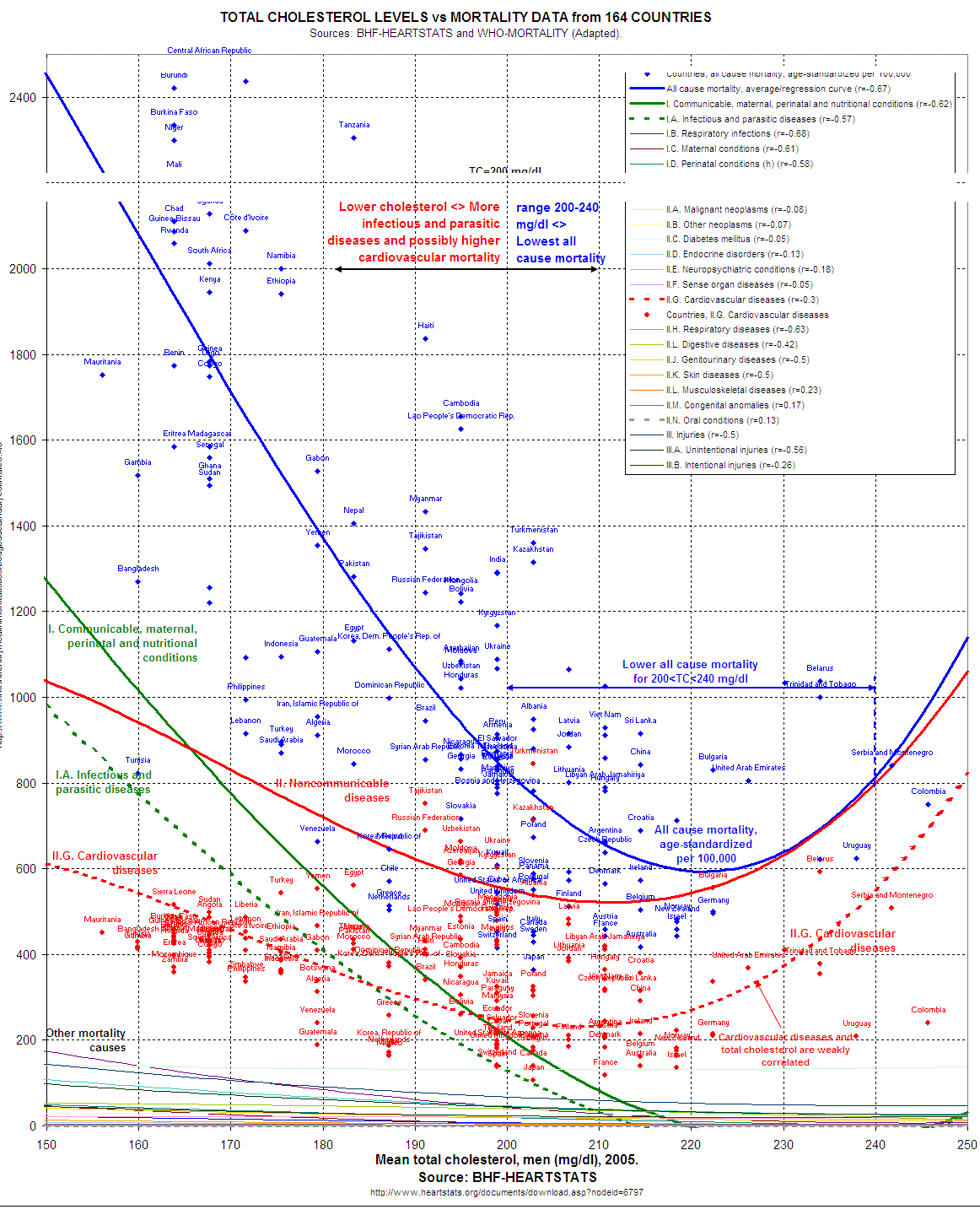
Death rate and diseases all DECREASE as Cholesterol increased in 167 countries
in 167 countries Death rate, infectious diseases - - - non-communicable, cardio - -
All decrease as Cholesterol is increased