
People entering hospital with pneumonia with low Vitamin D were 3.5 X more likely to die in 3 months - Nov 2025
eCollection 2025 Dec.
Vitamin D Deficiency at Hospital Admission With Community-Acquired Pneumonia is Associated With Increased Risk of Mortality: A Prospective Cohort Study
Open Forum Infect Dis. 2025 Nov 19;12(12):ofaf706. doi: 10.1093/ofid/ofaf706.
Maria Hein Hegelund 1, Sehrash Alam 1, Arnold Matovu Dungu 1, Camilla Koch Ryrsø 1 2, Daniel Faurholt-Jepsen 3 4, Rikke Krogh-Madsen 2 4 5, Tomas Oestergaard Jensen 1 6, Christian Mølgaard 7, Birgitte Lindegaard 1 2 4
Background: A deficient vitamin D status is linked to increased risk of community-acquired pneumonia (CAP) and both short- and long-term mortality. Given small sizes of previous studies and lack of adjustment for key confounders, we aimed to investigate the association between vitamin D status (sufficient, insufficiency, or deficiency) and mortality risk in adults hospitalized with CAP.
Methods: This study, nested within the Surviving Pneumonia Study at Copenhagen University Hospital-North Zealand, Denmark, included adults hospitalized with CAP between 2019 and 2022. Vitamin D status was assessed using serum 25(OH)D concentrations, categorizing participants as sufficient (≥50 nmol/L), insufficient (25-<50 nmol/L), or deficient (<25 nmol/L). Logistic regression was used to assess mortality risk. Covariates included age, sex, Charlson comorbidity index, CURB-65, smoking history, and BMI.
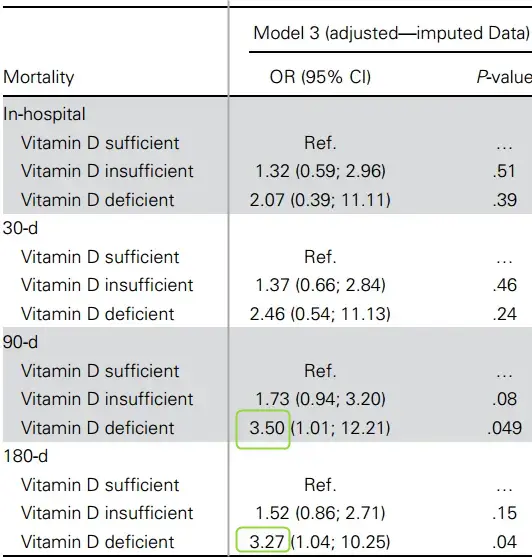
Results: Among 514 participants, 29 (5.6%) and 130 (25.3%) had deficient and insufficient vitamin D status, respectively. Participants with deficient vitamin D status were younger, and more than 50% were current smokers. Vitamin D deficiency was associated with higher 90-day (OR: 3.50, 95% CI 1.01; 12.21) and 180-day (OR: 3.27, 95% CI 1.04; 10.25) mortality risk compared with participants with sufficient vitamin D status, while no difference was observed between the sufficient and insufficient group. No differences were observed for in-hospital or 30-day mortality.
Conclusions: Participants with deficient vitamin D status were younger and faced higher mortality risk despite milder disease at admission. Given that vitamin D deficiency may relate to poorer health habits and low levels of other micronutrients, trials on tailored micronutrient supplementation during acute conditions like CAP could be considered.