
Flame Retardants might also be active vitamin D retardants
Do Flame Retardants Promote Vitamin D Deficiency?
Honor Thesis Audrey Petteruti University of New Hampshire -arc63@wildcats.unh.edu
With only 7 rats the 20% decline was not statistically significant
ABSTRACT
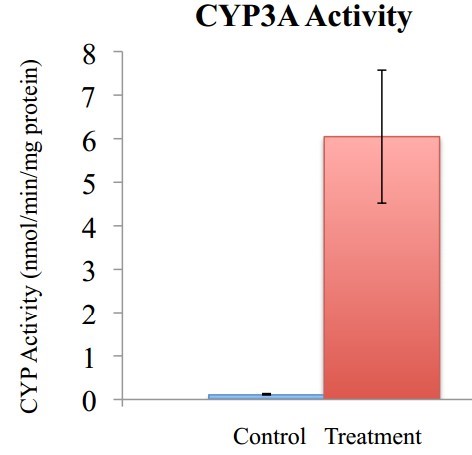
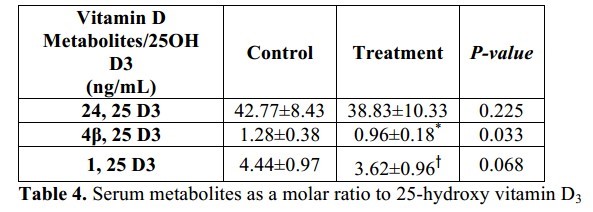
Vitamin D deficiency in the Unites States has become more prevalent in recent years. Research has shown that environmental chemicals such as flame-retardants induce hepatic enzymes in the cytochrome P450 family such as CYP24 and CYP3A that are important in vitamin D metabolism. To determine if exposure to one class of flame- retardants known as polybrominated diethyl ethers (PBDEs) promotes vitamin D deficiency, 15 rats consumed a diet marginally deficient in Vitamin D - 85 IU Vitamin D/kg diet - for 56 days. On day 28 of the experiment, 7 rats were gavaged daily with 7 mg/kg BW PBDEs and 8 rats were gavaged daily with corn oil, for 28 days. Body weight and food intake were measured three times a week, vitamin D status markers in the urine were measured at weeks 4 and 8 and blood Vitamin D metabolites along with liver weight were measured at euthanization. Liver microsomal vitamin D metabolism, composition and CYP3A enzyme activity were also measured. The final body weight tended to be lower in the treatment animals than in the control but was not significantly different (370.29±40.12 vs. 400.63±31.99, respectively, p = 0.0636). Liver from PBDE- treated rats was significantly heavier than liver from control rats (15.67±1.99 vs. 12.71±0.98, respectively) p < 0.05. Liver as a percent of body weight was also significantly greater in treatment (4.24±0.2) compared to control (3.18±0.13). There was no significant difference in the lipid composition of the liver or urine metabolites between PBDE-treated and control rats. The inactive metabolites 24, 25-dihydroxy vitamin D3 and 4p, 25-dihydroxy vitamin D3 did not show significant difference between control and treatment groups. The active form of 1, 25-vitamin D3 tended to be lower in the PBDE-treated rats than in the control (0.071±0.027 vs. 0.082±0.018, respectively, p = 0.187). When expressed as a ratio to 25(OH)D3, 4p, 25-dihydroxyD3 was significantly lower in treatment rats compared to control (0.96±0.18 vs. 1.28±0.38, respectively) and 1 25-dihydroxyD3 tended to be lower in treatment compared to control (3.62±0.96 vs. 4.44±0.97, p = 0.068). Enzymatic CYP3A levels were significantly higher in PDBE- treated rats than in control (6.047±1.53 vs. 0.103±0.032 nmol/min/mg protein, respectively). The hypothesis that the induction of CYP3A by PBDEs may accelerate vitamin D inactivation, leading to vitamin D deficiency was not supported by the findings, as there was no significant change in serum vitamin D levels in the PBDE- treated rats.
See also VitaminDWiki
- 43 reasons for Vitamin D deficiency
- reasons focus on results of vitamin D tests, which are not changed by flame retardants
See also web
Flame Retardants and DEET Now in Swimming Pools Mercola Jan 2015
Experts Fear Flame Retardants Are Triggering a Health Crisis Mercola Jan 2020
"reduction in IQ as well as fertility issues and a potential increased risk of diabetes" all are related to low vitamin D
:In a review 100 pure reviewed studies, the scientists found OPFRs are often at levels 10 to 100 times higher in the water, air and dust than were (previous) PBDEs"
Found in: Car seats, Paints, Wire and cable coating, Carpet padding, Building insulation, Textiles. Infant mattresses. Television cases, Fabric blinds
Americans Have More Toxic Flame Retardants in Their Bodies Than Previously Thought Mercola Nov 2014
Flame retardant exposure during pregnancy lowers IQ in children Nov 2014 Natural News – PBDE
Flame Retardants in Soda and Furniture Lower IQ, Slows Development Natural Society Nov 2012
Flame Retardants Wikipedia
- EU banned several types of PBDEs in 2004 and 2008
- A number of recent studies suggest that dietary intake is one of the main routes to human exposure to PBDEs.
- New foam items that you purchase today are unlikely to contain PBDE
- Flame retardants in consumer products are linked to health and cognitive problems Washington Post April 2013
- thyroid disruption, memory and learning problems, delayed mental and physical development, lower IQ, advanced puberty and reduced fertility
- Since the 1970s, they have been applied to textiles, foam in couches and baby products, building insulation, carpets, drapes, personal computers, TV sets, car dashboards, electrical cables and many other products.
- During the past 30 years PBDE levels in human blood, milk and tissue increased by a factor of 100 — essentially doubling every five years
- (Vitamin D not mentioned)
- Flame Retardants Linked to Lower IQs, Hyperactivity in Children Scientific American May 2013
- If mother’s blood had a 10-fold increase in PBDEs, the average five-year-old had about a four-point IQ deficit.
- (Vitamin D not mentioned)